
An effective Affiliate Marketing KPI Guide covers the core metrics—Conversion Rate, CTR, CPA, ROAS, and AOV—alongside the right tracking tools and UTM parameters needed to measure affiliate program performance accurately. Marketers who track these KPIs consistently make smarter budget decisions and grow affiliate revenue faster.
Affiliate marketing generates over $8 billion in annual revenue in the U.S. alone (Statista, 2023), yet a surprising number of programs underperform—not because the affiliates are weak, but because the teams managing them are flying blind. Without a structured Affiliate Marketing KPI Guide, it’s nearly impossible to know which partnerships are delivering real value and which are quietly draining your budget.
This guide is built for marketers, affiliate managers, and business owners who want to move beyond surface-level metrics. You’ll learn which KPIs actually matter, how to set up UTM Tracking for Affiliates, how to configure Google Analytics for Affiliate Marketing, which Best Affiliate Tracking Tools are worth your investment, and how to build CPA Affiliate Partnerships that scale.
Whether you’re launching your first affiliate program or auditing an existing one, this Affiliate Marketing KPI Guide gives you a practical, step-by-step framework to measure performance, eliminate waste, and grow with confidence.
What Are Affiliate Marketing KPIs and Why Do They Matter?

KPIs—Key Performance Indicators—are the specific, measurable data points that tell you whether your affiliate program is moving in the right direction. In the context of affiliate marketing, KPIs bridge the gap between affiliate activity and actual business outcomes like revenue, customer acquisition, and profitability.
A solid Affiliate Marketing KPI Guide doesn’t just list metrics—it connects each metric to a business objective. For example, tracking Cost Per Acquisition (CPA) tells you how efficiently you’re converting affiliate traffic into paying customers. Tracking Return on Ad Spend (ROAS) tells you whether your affiliate spend is generating a worthwhile return. Together, these metrics form the backbone of any performance-driven affiliate program.
The key principle: what you measure, you can manage. Programs that rely on gut instinct over data consistently overpay underperforming affiliates and miss opportunities to reward high-value partners.
The 5 Essential KPIs Every Affiliate Manager Should Track
1. Conversion Rate
Conversion Rate measures the percentage of affiliate-referred visitors who complete a desired action—typically a purchase. It’s calculated as: (Conversions ÷ Clicks) × 100.
A low conversion rate can signal misaligned landing pages, weak offers, or poor audience targeting by the affiliate. This is often the most revealing metric in any Affiliate Marketing KPI Guide, because it exposes the quality of traffic—not just its volume.
Industry benchmark: Average affiliate conversion rates typically fall between 0.5% and 1%, though top-performing programs in niche verticals can reach 3–5% (AM Navigator, 2023).
2. Click-Through Rate (CTR)
CTR measures how many people clicked on an affiliate link relative to how many saw it. High CTR with low conversions suggests a disconnect between the affiliate’s audience and your offer. Low CTR may indicate weak creative assets or misaligned messaging.
3. Cost Per Acquisition (CPA)
CPA tells you exactly what it costs to acquire one customer through affiliate activity. It’s a foundational metric for building sustainable CPA Affiliate Partnerships, because it determines whether your commission structure is financially viable at scale.
Formula: Total Affiliate Spend ÷ Total Conversions = CPA
4. Return on Ad Spend (ROAS)
ROAS measures the revenue generated for every dollar spent on affiliate commissions and fees. A ROAS of 4:1 means you’re earning $4 for every $1 spent. This metric is essential for evaluating campaign efficiency across different affiliate channels and partners.
5. Average Order Value (AOV)
AOV tracks the average dollar value of each transaction driven by affiliates. Affiliates with high AOV often deliver better lifetime value customers—even if their conversion volume is lower. Combining AOV with CPA gives a more complete picture of affiliate profitability.
How to Set Up UTM Tracking for Affiliates
UTM parameters are short tags appended to URLs that tell Google Analytics (and other platforms) exactly where a visitor came from. For affiliate programs, UTM Tracking for Affiliates is non-negotiable—without it, affiliate-driven traffic blends into your organic or direct traffic data, making attribution nearly impossible.
A standard UTM URL for an affiliate looks like this: UTM Tracking for Affiliates: The Complete Guide
Best practices for UTM Tracking for Affiliates:
- Standardize naming conventions across all affiliates. Inconsistent UTM naming (e.g., “affiliate” vs. “Affiliate” vs. “aff”) creates fragmented data in your reports.
- Use a UTM builder like Google’s Campaign URL Builder to avoid typos and formatting errors.
- Assign unique UTMs per affiliate and campaign so you can compare performance at a granular level.
- Never reuse UTM parameters across different campaigns or partners.
Clean UTM data feeds directly into more accurate reporting in Google Analytics for Affiliate Marketing and any dedicated affiliate tracking platform you use.
Configuring Google Analytics for Affiliate Marketing
Google Analytics 4 (GA4) is a powerful—and free—foundation for affiliate performance tracking. When configured correctly, Google Analytics for Affiliate Marketing enables custom conversion tracking, multi-touch attribution modeling, and detailed channel performance breakdowns.
Key setup steps for Google Analytics for Affiliate Marketing:
- Create a custom channel group that isolates affiliate traffic from other referral sources.
- Set up conversion events that match your affiliate goals (e.g., purchases, sign-ups, form completions).
- Build Exploration reports to analyze affiliate-specific UTM data, user journeys, and conversion paths.
- Enable cross-channel attribution to understand how affiliates contribute alongside paid and organic channels.
GA4’s data-driven attribution model is particularly useful for programs with long sales cycles, as it distributes credit across multiple touchpoints rather than assigning all value to the last click. This makes Google Analytics for Affiliate Marketing significantly more accurate than last-click reporting alone.
The Best Affiliate Tracking Tools Available in 2025
While Google Analytics covers the basics, dedicated platforms offer richer affiliate-specific features. The Best Affiliate Tracking Tools combine real-time reporting, fraud detection, automated payouts, and deep integrations with e-commerce platforms.
Top platforms to consider:
|
Tool |
Best For |
Key Feature |
|---|---|---|
|
Impact |
Enterprise programs |
Advanced partner discovery & contract management |
|
ShareASale |
SMBs and bloggers |
Large affiliate marketplace |
|
PartnerStack |
SaaS companies |
B2B partner management |
|
Tapfiliate |
E-commerce (Shopify/WooCommerce) |
Simple setup, deep integrations |
|
Post Affiliate Pro |
Custom setups |
Flexible commission structures |
The Best Affiliate Tracking Tools share three core capabilities: accurate click-to-conversion tracking, real-time dashboards, and reliable fraud detection. When evaluating platforms, prioritize tools that integrate natively with your CRM, e-commerce platform, and existing analytics stack.
Affiliate Tracking Explained: How the Technology Works
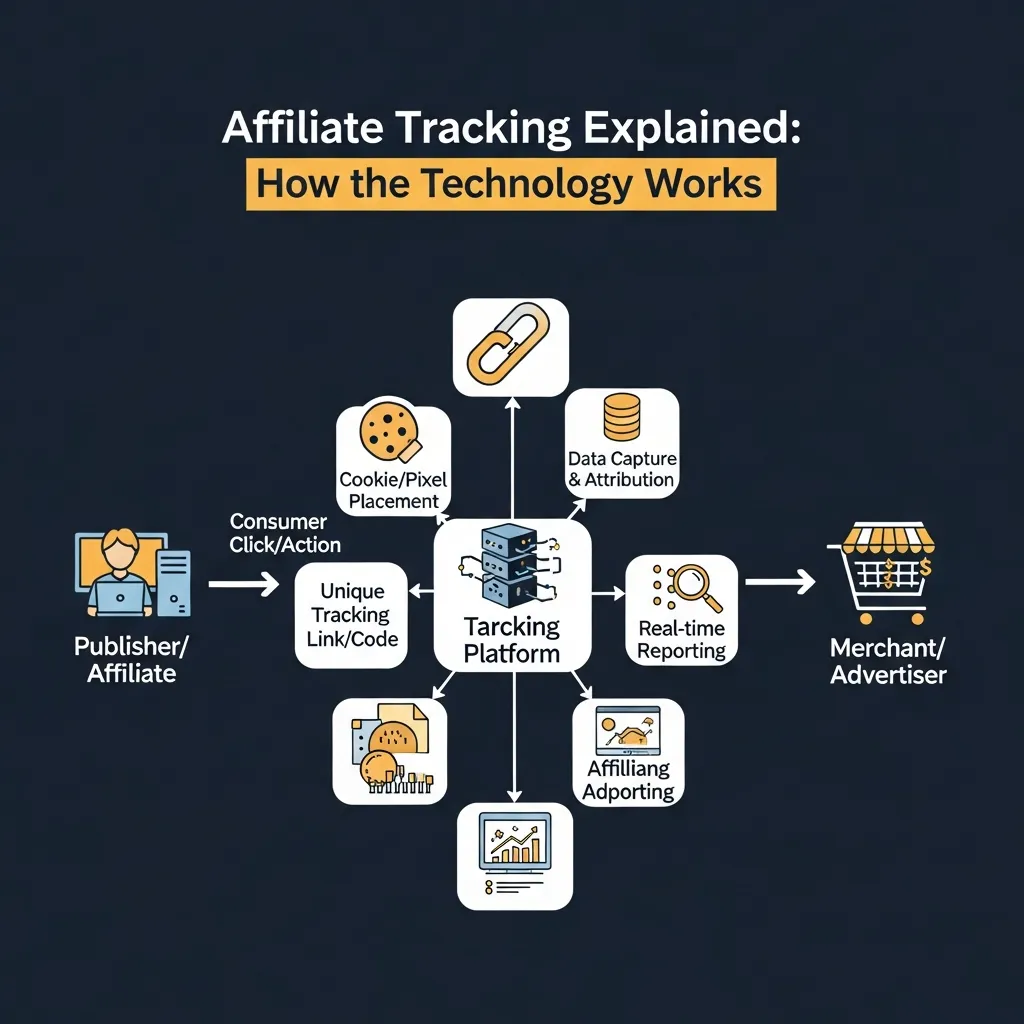
Understanding Affiliate Tracking Explained at a technical level helps you prevent data loss, resolve attribution disputes, and catch fraud early.
The basic data flow in affiliate tracking:
- A user clicks an affiliate link containing a unique affiliate ID.
- A tracking cookie (or server-side token) is placed on the user’s browser.
- The user completes a purchase or conversion on your site.
- The tracking pixel or postback URL fires, passing conversion data back to your affiliate platform.
- The commission is attributed to the referring affiliate.
Common tracking errors to avoid:
- Cookie blocking: iOS and browser privacy updates increasingly block third-party cookies. Server-side tracking or first-party cookies reduce this risk.
- Duplicate transactions: Without proper deduplication logic, the same conversion can be credited to multiple affiliates. Set clear deduplication rules in your Affiliate Marketing Tools.
- Pixel misfires: A tracking pixel that fails to load on your confirmation page means lost conversion data. Test pixel firing regularly using browser developer tools.
Affiliate Tracking Explained correctly is the difference between a program you can trust and one that hemorrhages budget to attribution errors.
Building High-Performance CPA Affiliate Partnerships
CPA Affiliate Partnerships are commission arrangements where affiliates earn a fixed fee per completed action—typically a sale, lead, or sign-up. This model aligns affiliate incentives directly with business outcomes, making CPA one of the most cost-efficient structures for performance marketing.
How to build sustainable CPA Affiliate Partnerships:
- Set CPA targets based on your unit economics. If your Customer Lifetime Value (CLV) is $200 and your target CPA is $40, you’re working with a 5:1 CLV-to-CPA ratio—a healthy margin.
- Tier your commission structure. Reward affiliates who consistently exceed volume or quality benchmarks with higher CPA rates.
- Include quality controls. Track refund rates, chargeback rates, and customer retention per affiliate. High-volume affiliates who drive poor-quality customers can be more damaging than low-volume ones.
Typical CPA commission rates vary widely by industry: financial services can reach $50–$200 per lead, while e-commerce typically ranges from $5–$30 per sale (CJ Affiliate, 2023).
Essential Affiliate Marketing Tools to Scale Your Program
Beyond tracking and analytics, a mature affiliate program relies on a stack of Affiliate Marketing Tools that handle communication, creative management, and automation.
Core Affiliate Marketing Tools by function:
- Recruitment: Impact, PartnerStack, or LinkedIn for finding new affiliates
- Creative management: Brafton, Brandfolder, or Google Drive for sharing ad assets
- Communication: Tipalti or PayQuicker for automated payouts
- Fraud detection: TrafficGuard or Fraudlogix for click fraud monitoring
- Reporting: Supermetrics or Looker Studio for aggregating multi-platform data
Automation is the key to scaling. The right Affiliate Marketing Tools eliminate manual reporting, reduce payment errors, and free affiliate managers to focus on strategy rather than spreadsheets.
How to Analyze KPI Data and Take Action
Data without action is just noise. The final step in any Affiliate Marketing KPI Guide is translating metrics into decisions.
A practical framework for KPI analysis:
- Segment by affiliate tier. Compare top 20% of affiliates (by revenue) to the rest. Identify what the high performers do differently.
- Look for CTR-to-conversion drop-offs. High CTR + low conversion = traffic quality issue. Low CTR + high conversion = reach issue. Each requires a different fix.
- Flag outliers. An affiliate with a dramatically higher conversion rate may be using misleading content or targeting returning customers—investigate before rewarding.
- Review monthly, optimize quarterly. Monthly reviews catch issues early. Quarterly optimization sessions are where you restructure commissions, pause underperformers, and scale what’s working.
The goal of this Affiliate Marketing KPI Guide isn’t to generate more reports—it’s to make faster, more confident decisions based on reliable data.
The Long Game: Why Consistent KPI Tracking Builds Better Affiliate Programs

The affiliate programs that outperform year after year aren’t necessarily the ones with the biggest budgets or the most affiliates. They’re the ones with the tightest feedback loops—programs where data flows cleanly, attribution is accurate, and every commission dollar is traceable to a business outcome.
Building that kind of program starts with the fundamentals covered in this Affiliate Marketing KPI Guide: defining the right KPIs, implementing clean UTM Tracking for Affiliates, configuring Google Analytics for Affiliate Marketing correctly, selecting the Best Affiliate Tracking Tools for your stack, and structuring CPA Affiliate Partnerships around real unit economics.
The competitive advantage in affiliate marketing increasingly belongs to those who understand their data—not just those who have it. Start implementing your tracking strategy today, and the compounding benefits of cleaner attribution and smarter optimization will follow.
Frequently Asked Questions
What is the most important KPI in affiliate marketing?
Conversion Rate and Cost Per Acquisition (CPA) are the two most critical KPIs in any Affiliate Marketing KPI Guide. Conversion Rate measures traffic quality, while CPA determines whether your affiliate program is financially sustainable. Together, they give you the clearest picture of program health.
How often should I review affiliate marketing KPIs?
Review affiliate marketing KPIs monthly to catch performance issues early. Conduct deeper strategic reviews quarterly to restructure commission rates, pause underperforming affiliates, and scale high-value partnerships. Real-time dashboards from your affiliate tracking tools allow for ongoing monitoring between formal reviews.
What’s the difference between UTM Tracking for Affiliates and other tracking methods?
UTM Tracking for Affiliates uses URL parameters to pass campaign data to analytics platforms like GA4. Other methods—such as server-side postback tracking or pixel-based tracking—work at the server or browser level rather than at the URL level. UTM tracking is best for analytics segmentation; postback tracking is more reliable for conversion attribution, especially when cookies are blocked.
How does Google Analytics for Affiliate Marketing compare to dedicated affiliate tracking tools?
Google Analytics for Affiliate Marketing is excellent for multi-channel attribution, audience analysis, and conversion path tracking. Dedicated affiliate platforms (like Impact or Tapfiliate) add affiliate-specific features such as commission management, automated payouts, and recruitment tools. Most mature programs use both: GA4 for analytics, a dedicated platform for program management.
What makes the Best Affiliate Tracking Tools stand out?
The Best Affiliate Tracking Tools combine accurate real-time attribution, fraud detection, flexible commission structures, and native integrations with popular e-commerce and CRM platforms. Ease of use for affiliates is equally important—tools that make it hard for affiliates to access their links and reports tend to reduce partner engagement.
How does affiliate tracking help prevent fraud?
Affiliate Tracking Explained in the context of fraud prevention focuses on detecting click stuffing, cookie hijacking, and fake leads. Quality affiliate tracking tools flag anomalies like unusually high CTR-to-conversion gaps, traffic from suspicious IP ranges, or sudden spikes in volume from a single affiliate—all common indicators of fraudulent activity.
What are typical CPA Affiliate Partnerships commission rates?
CPA Affiliate Partnerships commission rates vary significantly by industry. E-commerce programs typically pay $5–$30 per sale. Financial services and insurance can range from $50–$200+ per lead. SaaS companies often offer a percentage of first-year subscription value. Always set CPA rates based on your actual Customer Lifetime Value to maintain profitability.
Which Affiliate Marketing Tools integrate best with Shopify and WooCommerce?
Tapfiliate, Refersion, and LeadDyno are among the Affiliate Marketing Tools with the strongest native integrations for Shopify. For WooCommerce, AffiliateWP is widely regarded as the most seamless option. All four offer one-click setup, real-time sales tracking, and automated commission calculations without requiring custom development.
How can I improve my conversion rates with better KPI tracking?
Better KPI tracking improves conversion rates by identifying exactly where the drop-off occurs. If CTR is high but conversions are low, the issue is likely landing page relevance or offer mismatch—not the affiliate. If CTR is low, the creative or placement needs work. Use UTM data in GA4 to trace the full journey from click to conversion and isolate the friction point.
What’s a good benchmark for affiliate marketing ROI?
A healthy affiliate marketing ROI benchmark is a ROAS of 4:1 or higher—meaning $4 in revenue for every $1 in affiliate spend. However, this varies by industry, margin structure, and whether you’re optimizing for customer acquisition or long-term lifetime value. Programs with high AOV and strong retention can operate profitably at lower ROAS ratios.
How do I prevent double-counting in affiliate attribution?
Preventing double-counting requires clear deduplication logic in your affiliate tracking platform and a defined rule for how credit is assigned when multiple affiliates touch the same customer journey. Most programs use a last-click model, meaning only the final affiliate link clicked before conversion receives credit. Document and communicate this policy to all affiliates upfront.
What’s the future of Affiliate Marketing KPI Guide technology?
The future of Affiliate Marketing KPI Guide technology is moving toward server-side tracking, AI-powered attribution modeling, and real-time performance optimization. As browser privacy restrictions continue to limit cookie-based tracking, first-party data strategies and server-to-server integrations will become the standard. AI tools will increasingly automate anomaly detection, commission optimization, and affiliate recruitment.