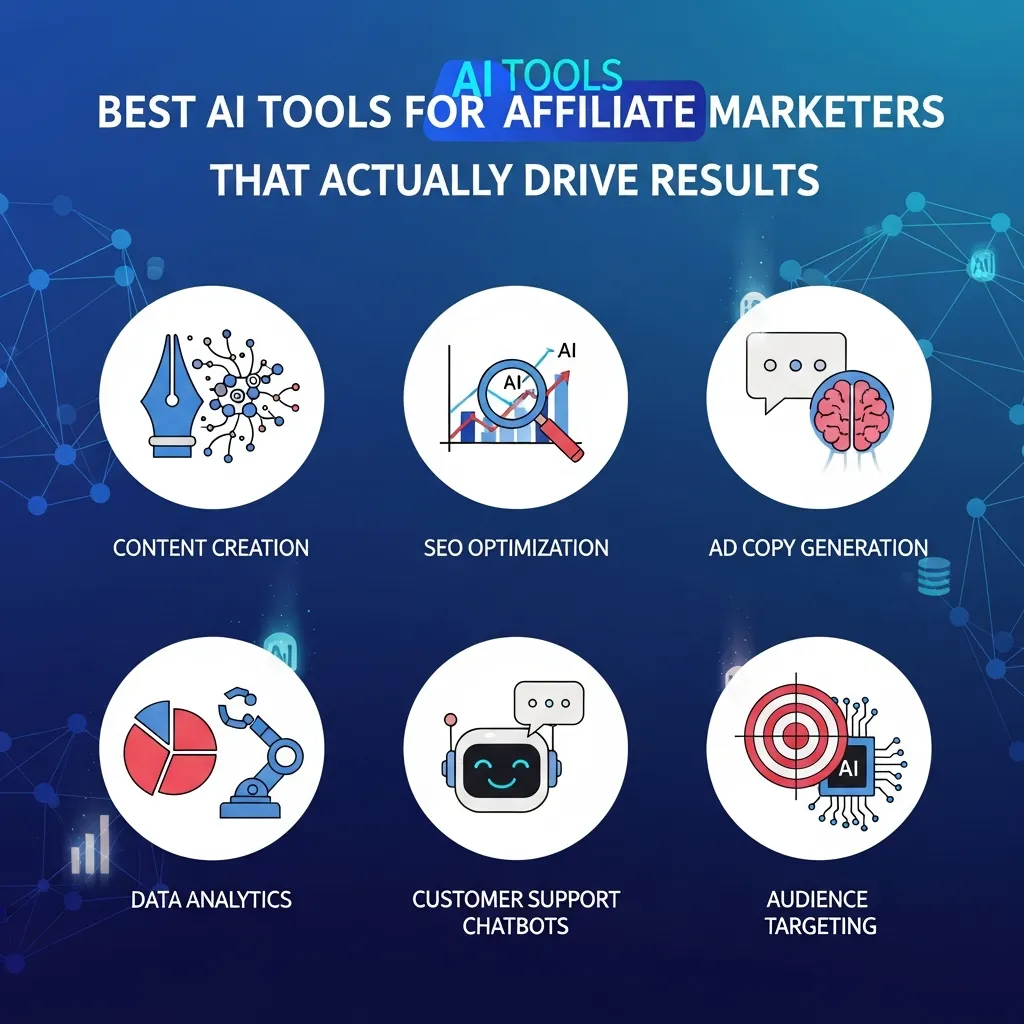
The best AI tools for affiliate marketers automate campaign management, sharpen audience targeting, improve UTM tracking for affiliates, and deliver predictive analytics that boost ROI. Platforms like SEMrush, Jasper, Surfer SEO, Voluum, and Google Analytics with AI integrations are leading choices for affiliates looking to scale smarter and faster.
Affiliate marketing has never been more competitive. What once required a small budget and a basic website now demands multi-channel strategies, data-driven decision-making, and near-real-time campaign adjustments. The marketers who are winning today aren’t necessarily working harder—they’re working with better tools.
AI has fundamentally changed how affiliate campaigns are planned, executed, and optimized. From automated UTM tracking for affiliates to machine learning-powered audience segmentation, the technology removes guesswork from the equation. Instead of reacting to performance data days after the fact, AI tools for marketing allow affiliates to anticipate trends, allocate budgets more accurately, and personalize content at scale.
This post breaks down the best AI tools for affiliate marketers across every key function—analytics, tracking, content creation, market intelligence, and campaign optimization. You’ll also find a practical affiliate marketing KPI guide, tips for setting up Google Analytics for affiliate marketing, and answers to 12 of the most common questions affiliates ask about AI. Whether you’re managing three campaigns or thirty, there’s something actionable here for you.
How AI Tools Are Transforming Affiliate Marketing
The traditional affiliate workflow—pick an offer, drive traffic, check stats, repeat—no longer cuts it. Advertisers expect precision. Networks reward consistency. Audiences demand relevance.
AI tools for affiliate marketers address all three demands simultaneously. Machine learning algorithms can analyze thousands of data points across campaigns to identify what’s working before a human analyst could even open a spreadsheet. Automation platforms handle repetitive tasks like bid adjustments, creative rotation, and email sequencing without manual input. Content generation AI produces ad copy, landing page variants, and social posts at a pace no copywriter can match alone.
The result? Affiliates who adopt AI tools for marketing gain a compounding advantage. Every optimized campaign generates better data. Better data trains smarter models. Smarter models improve the next campaign.
Best AI Tools for Affiliate Marketers
AI-Powered Analytics Platforms for Performance Monitoring
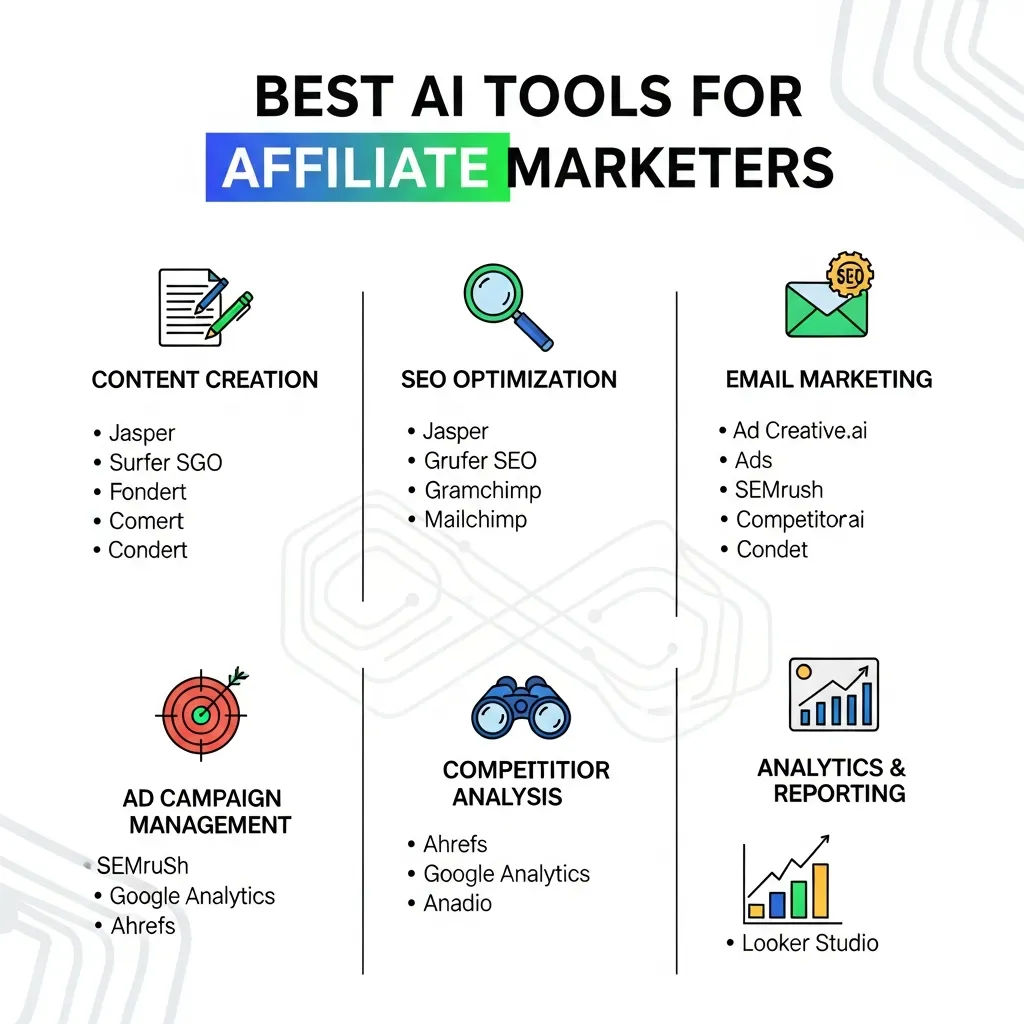
Voluum is one of the most widely used AI-powered trackers in affiliate marketing. Its Automizer feature uses rule-based AI to pause underperforming traffic sources, scale winning creatives, and adjust bids automatically. Affiliates running paid traffic campaigns benefit most from its real-time reporting and bot traffic filtering.
For content-driven affiliates, Surfer SEO and Clearscope use AI to optimize articles for search intent, keyword density, and topical authority—helping organic campaigns gain visibility faster.
Machine Learning Tools for Audience Segmentation and Targeting
Audience targeting is where machine learning delivers its clearest return. Platforms like Audiense and Facebook’s Advantage+ use behavioral data to identify high-converting user segments automatically. Rather than manually building lookalike audiences, affiliates can let AI refine targeting parameters based on live conversion signals.
AdCreative.ai generates conversion-optimized ad creatives using predictive scoring—ranking which images and headlines are most likely to perform before a campaign even launches.
Automation Platforms for Campaign Management and Optimization
Revealbot and Madgicx are built specifically for paid social affiliates. Both platforms automate campaign rules, budget pacing, and creative testing using machine learning. Affiliates managing Meta or TikTok campaigns report significant time savings and improved cost-per-acquisition when using these tools.
For email affiliates, ActiveCampaign’s AI features automate send-time optimization, subject line testing, and list segmentation based on subscriber behavior.
Content Generation AI for Scaling Creative Assets
Jasper remains one of the most capable AI writing platforms for affiliates who need to produce high volumes of content—product reviews, comparison pages, email sequences, and ad copy. Jasper’s brand voice settings and SEO integrations make it particularly useful for teams scaling across multiple niches.
Copy.ai and Writesonic are strong alternatives, especially for short-form ad copy and social media content.
Essential Metrics and KPIs — An Affiliate Marketing KPI Guide
Which KPIs Matter Most for Affiliate Marketers?
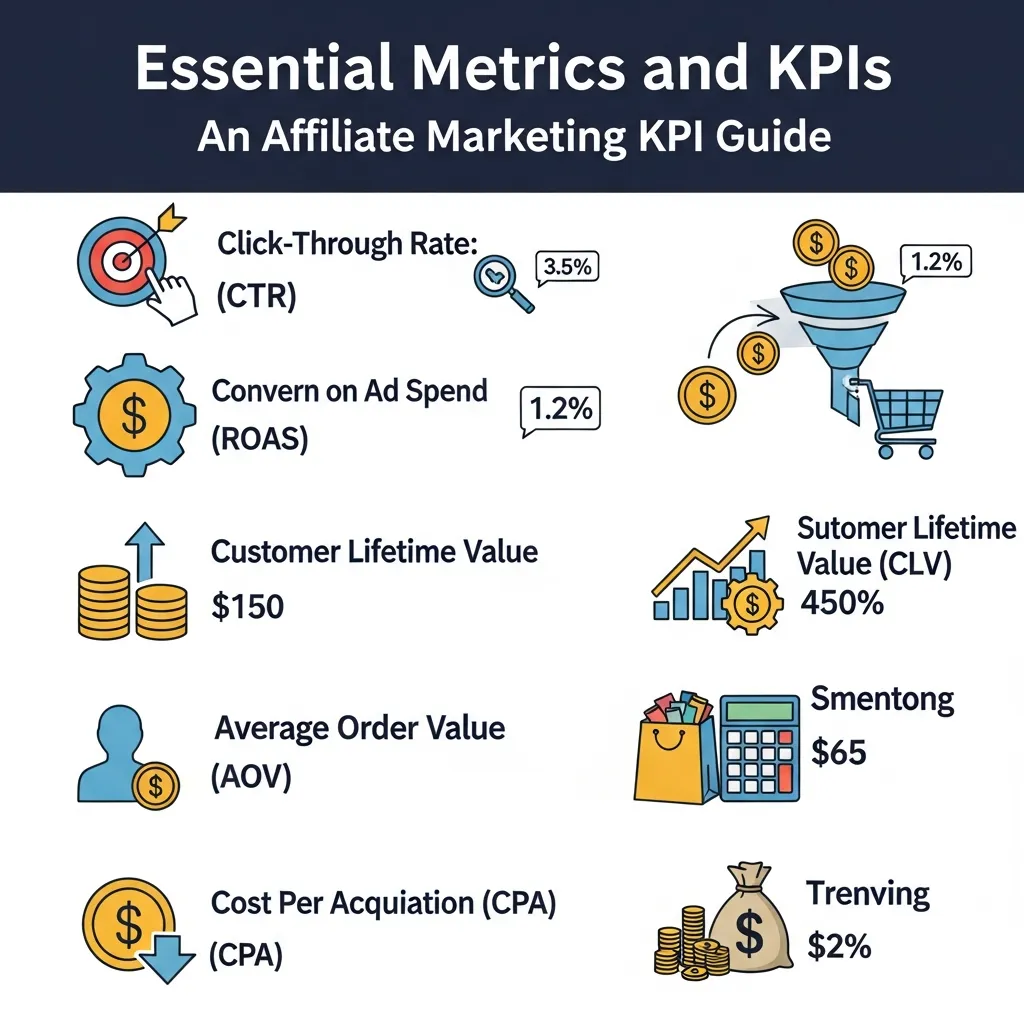
An effective affiliate marketing KPI guide focuses on a core set of metrics that directly reflect campaign profitability and scalability:
- Conversion Rate (CR): The percentage of clicks that result in a desired action (sale, lead, install). Industry benchmarks vary widely by vertical, but a CR above 2% is considered solid for most e-commerce offers.
- Earnings Per Click (EPC): Total earnings divided by total clicks. EPC is one of the most useful benchmarks for comparing offers and traffic sources.
- Return on Investment (ROI): Net profit divided by total spend, expressed as a percentage. Positive ROI is the baseline; sustainable ROI is the goal.
- Click-Through Rate (CTR): Measures creative and placement performance. Low CTR often signals a mismatch between the ad and the audience.
- Cost Per Acquisition (CPA): What you pay to generate one conversion. Affiliates need CPA below payout to remain profitable.
Using AI to Monitor and Predict KPI Trends
AI tools for marketing don’t just report on these KPIs—they forecast them. Platforms like Improvado and Supermetrics aggregate data from multiple affiliate networks and ad platforms, then use AI to flag anomalies, predict performance dips, and surface optimization opportunities before revenue is lost.
Setting up automated alerts for KPI thresholds means affiliates can respond to issues in hours, not days.
Tracking and Attribution — UTM Tracking for Affiliates
Why UTM Tracking Is Non-Negotiable for Affiliate Campaigns
UTM tracking for affiliates is the foundation of accurate attribution. Without properly structured UTM parameters, it’s nearly impossible to determine which traffic source, campaign, or creative drove a conversion—especially across multi-channel campaigns.
A standard UTM structure for affiliates includes:
- utm_source — identifies the traffic source (e.g., facebook, google, newsletter)
- utm_medium — identifies the channel (e.g., cpc, email, organic)
- utm_campaign — identifies the specific campaign
- utm_content — differentiates creatives or ad variations
- utm_term — captures keyword data for paid search
How AI Tools Automate UTM Parameter Generation and Management
Manual UTM management across dozens of campaigns is error-prone. Tools like UTM.io and Terminusapp allow teams to build UTM templates, enforce naming conventions, and auto-generate tracking URLs. When integrated with platforms like Google Analytics for affiliate marketing, these tools ensure clean, consistent data flows through every campaign.
Some affiliate trackers, including Voluum and RedTrack, automatically append and manage UTM parameters across traffic sources, eliminating human error entirely.
Common UTM Tracking Mistakes to Avoid
- Inconsistent capitalization (utm_source=Facebook vs. utm_source=facebook creates separate entries in analytics)
- Missing parameters on retargeting campaigns
- Failing to test links before launch
- Using spaces instead of hyphens or underscores in parameter values
Data Analysis and Insights — Google Analytics for Affiliate Marketing
Setting Up Google Analytics for Affiliate Marketing Correctly
Google Analytics for affiliate marketing requires specific configuration to be genuinely useful. Key setup steps include:
- Enabling e-commerce tracking or goal tracking for conversion events
- Filtering out internal traffic and bot traffic
- Linking Google Search Console to capture organic performance data
- Setting up custom channel groupings that reflect your affiliate traffic sources
Google Analytics 4 (GA4) introduces event-based tracking, which gives affiliates more granular insight into user behavior—scroll depth, video engagement, outbound clicks—that older session-based models couldn’t capture.
Integrating Google Analytics with AI Tools
GA4’s integration with Google’s AI-powered Looker Studio allows affiliates to build dynamic dashboards that surface predictive insights, including projected conversion rates and revenue forecasts based on current traffic trends. Pairing GA4 with Supermetrics or Funnel.io pulls affiliate network data alongside Google data for a unified performance view.
Advanced segmentation in GA4—filtering by device type, geography, traffic source, and user behavior—helps affiliates identify where high-value users come from and double down on those channels.
Market Intelligence Tools for Competitive Advantage
Identifying Emerging Opportunities with Market Intelligence Tools
Market intelligence tools give affiliate marketers visibility into competitor strategies, emerging keyword trends, and audience behavior shifts. SEMrush and Ahrefs are the most comprehensive platforms for this purpose. Both use machine learning to surface keyword gaps, track competitor backlink growth, and estimate organic traffic across any domain.
For paid traffic affiliates, SimilarWeb and SpyFu reveal which ad creatives and landing pages competitors are running—allowing affiliates to benchmark and iterate faster.
Trend Forecasting and Real-Time Data Monitoring
Google Trends, combined with AI tools for marketing like Exploding Topics, helps affiliates get ahead of rising niches before they become saturated. Exploding Topics specifically uses machine learning to identify search trends 6–18 months before they peak—giving early movers a significant advantage.
Real-time monitoring platforms like Brand24 track mentions, sentiment, and trending conversations across social media and news sources, helping affiliates pivot messaging quickly when audience behavior shifts.
AI Tools for Marketing — Campaign Optimization at Scale

A/B Testing Automation and Budget Allocation
Manual A/B testing is slow. AI-driven testing platforms like VWO and Optimizely run multivariate tests simultaneously, using machine learning to identify winning variants faster than traditional split tests allow.
For budget allocation, platforms like Albert.ai and Madgicx use AI to redistribute spend across channels and creatives in real time, maximizing return on ad spend (ROAS) without requiring constant manual intervention.
Personalization and Dynamic Content Recommendations
Dynamic content tools like Dynamic Yield and Personyze adjust landing page content based on visitor attributes—device type, location, referral source, and browsing behavior. For affiliates driving traffic to their own landing pages, this level of personalization can meaningfully improve conversion rates.
Email and Social Media Optimization with AI
AI tools for marketing like Phrasee optimize email subject lines using natural language generation, producing variants that outperform human-written copy in open rate tests. For social media, tools like Lately.ai repurpose long-form content into dozens of social posts automatically, extending the reach of every piece of content an affiliate produces.
Frequently Asked Questions
What are the best AI tools for affiliate marketers?
The best AI tools for affiliate marketers include Voluum for tracking and automation, Jasper for content generation, SEMrush for market intelligence, Surfer SEO for organic optimization, and Madgicx for paid social campaign management. The right combination depends on your traffic source, niche, and budget.
How can AI improve my affiliate marketing ROI?
AI improves affiliate marketing ROI by automating bid adjustments, identifying high-converting audience segments, predicting which creatives will perform best, and reducing wasted spend on underperforming traffic sources. Affiliates using AI-driven platforms typically see faster optimization cycles and higher EPC compared to manual management.
Which AI tools integrate with Google Analytics for affiliate marketing?
Supermetrics, Funnel.io, Improvado, and Looker Studio all integrate directly with Google Analytics for affiliate marketing. These platforms pull GA4 data alongside affiliate network metrics, enabling unified reporting and AI-powered forecasting from a single dashboard.
What is UTM tracking and why is it important for affiliates?
UTM tracking for affiliates involves adding parameter strings to URLs to identify the source, medium, campaign, and creative driving each click. Without UTM tracking, affiliates cannot accurately attribute conversions to specific campaigns or channels, making optimization nearly impossible.
How do I calculate key affiliate marketing KPIs?
Key affiliate marketing KPIs are calculated as follows: Conversion Rate = (Conversions ÷ Clicks) × 100; EPC = Total Earnings ÷ Total Clicks; ROI = ((Revenue − Cost) ÷ Cost) × 100; CPA = Total Spend ÷ Total Conversions. AI analytics platforms can automate these calculations and alert you when KPIs fall outside target ranges.
Can AI predict affiliate marketing trends?
Yes. AI tools for marketing like Exploding Topics, SEMrush Trends, and Google’s AI-powered forecasting in Looker Studio use machine learning to identify rising search trends, predict seasonal demand shifts, and surface emerging niches before they become mainstream.
What are market intelligence tools and how do they help affiliates?
Market intelligence tools are platforms that aggregate competitor data, keyword trends, audience behavior, and ad spend signals. For affiliates, tools like SEMrush, SimilarWeb, and SpyFu reveal which offers competitors are promoting, which keywords are driving traffic, and which ad creatives are running—enabling faster, more informed campaign decisions.
How do I use AI for audience segmentation in affiliate marketing?
AI-powered audience segmentation uses machine learning to group users by behavioral patterns, purchase intent, and demographic signals. Platforms like Audiense, Facebook Advantage+, and ActiveCampaign analyze real-time data to build and refine audience segments automatically, improving targeting precision without manual list building.
What’s the difference between AI tools for marketing and traditional analytics?
Traditional analytics platforms report on what happened. AI tools for marketing analyze historical and real-time data to predict what will happen and recommend actions. The key distinction is the shift from descriptive reporting to predictive and prescriptive intelligence.
How can AI automate my affiliate campaigns?
AI automates affiliate campaigns through rule-based and machine learning triggers that adjust bids, pause underperforming creatives, rotate ad variations, manage email sequences, and reallocate budgets—all without manual input. Platforms like Voluum Automizer, Revealbot, and Albert.ai handle these functions across different traffic types.
Which AI tools offer the best customer support for affiliates?
Voluum, SEMrush, and ActiveCampaign are consistently rated highly for customer support among affiliate marketers. All three offer dedicated onboarding, live chat, and extensive knowledge bases. Jasper provides a robust help center and community forum specifically for content-focused users.
How much does it cost to implement AI tools for affiliate marketing?
Costs vary significantly by platform and feature tier. Entry-level tools like Surfer SEO and Jasper start at approximately $19–$49 per month. Mid-tier platforms like SEMrush and Voluum range from $99–$299 per month. Enterprise-level AI tools for marketing like Improvado or Albert.ai are priced based on ad spend or custom contracts. Many platforms offer free trials, making it practical to test before committing.