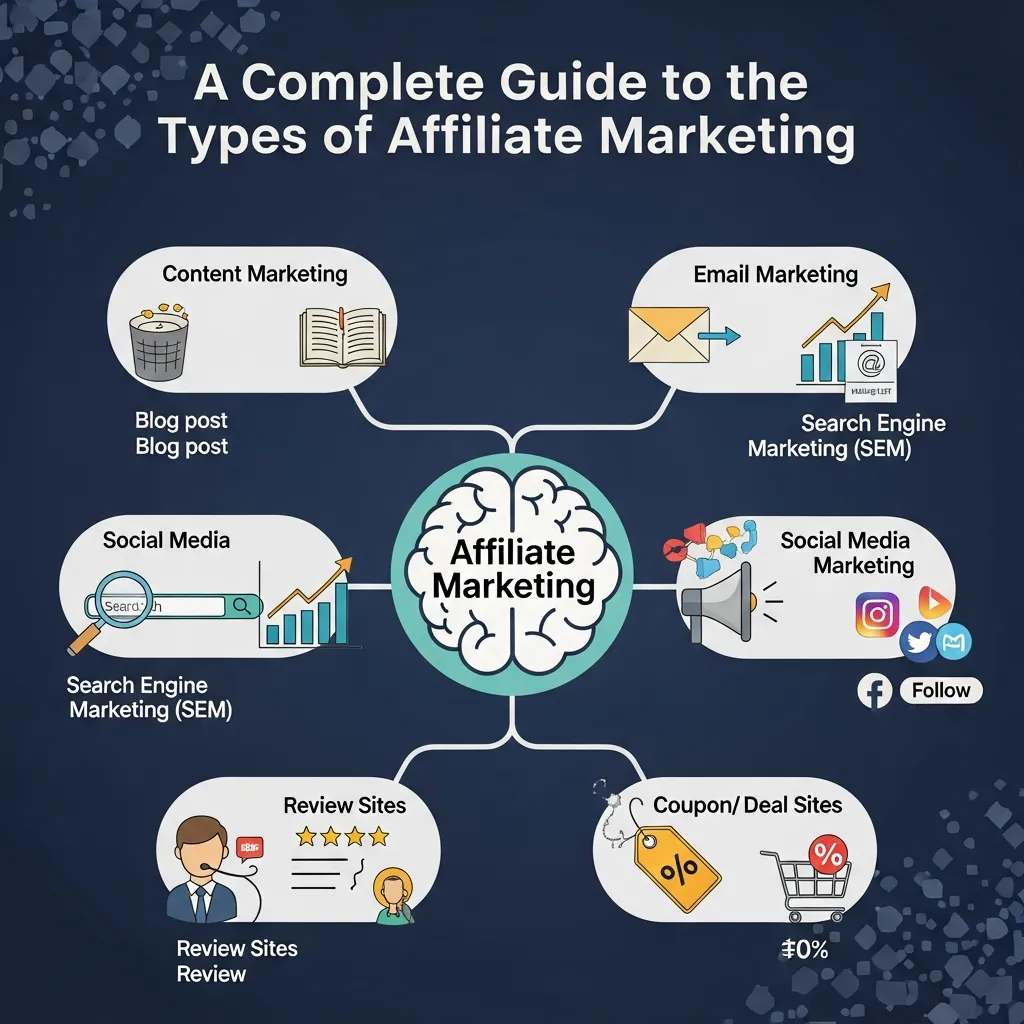
Affiliate marketing is a dynamic performance-based strategy where individuals or businesses earn a commission for promoting another company’s products or services. At its core, you find a product you like, promote it to others, and earn a piece of the profit for each sale or action that you generate. By leveraging various online platforms, marketers connect consumers with brands, creating a mutually beneficial ecosystem that drives sales and rewards promotional efforts.
Understanding the different types of affiliate marketing is crucial for anyone looking to build a sustainable income stream online. Not all programs are created equal, and the methods used to promote products vary wildly depending on the audience, the platform, and the specific goals of the campaign. By exploring the various models, commission structures, and promotional channels available, you can tailor your approach to maximize your earning potential and align with your personal strengths.
There is no single correct way to succeed in this industry. Some marketers excel at writing detailed product reviews, while others build massive audiences on social media. Knowing the distinct types of affiliate marketing empowers you to choose the right strategy for your unique situation.
Performance-Based Affiliate Marketing Models
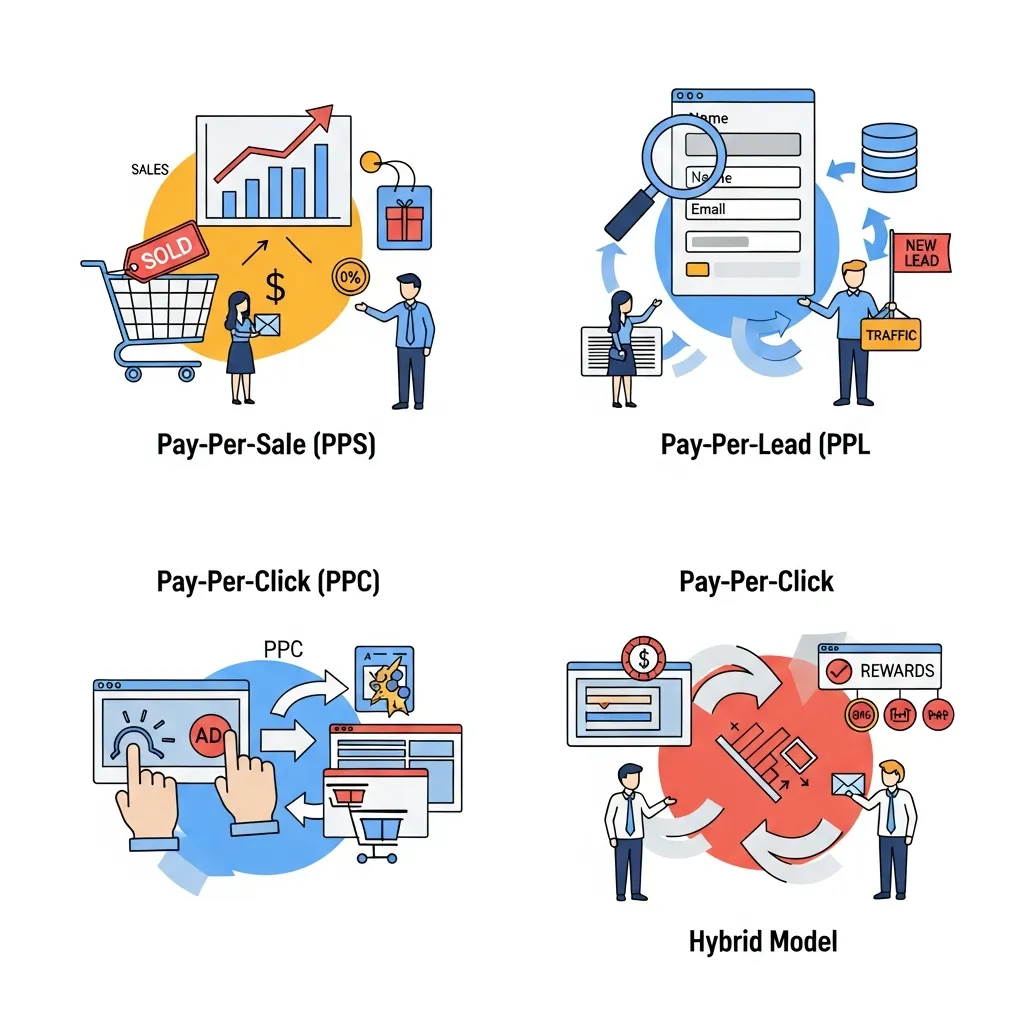
When you dive into the types of affiliate marketing, you quickly realize that compensation is tied directly to performance. The specific action that triggers a payout can differ significantly from one program to another.
Cost Per Action (CPA) Affiliate Marketing Explained
CPA is a popular model where the affiliate is paid when a user takes a specific action, rather than just making a purchase. Having cost per action (CPA) affiliate marketing explained simply means that the advertiser defines what a “conversion” is.
This action could be signing up for a free trial, downloading a software application, or filling out a detailed form. Because the user does not necessarily have to spend money, conversion rates for CPA offers are often higher than traditional sales models. Affiliates benefit from this lower barrier to entry, making it an excellent starting point for those building their traffic sources.
Cost Per Sale (CPS) Affiliate Marketing Guide
The most traditional and widely recognized model is CPS. A thorough cost per sale (CPS) affiliate marketing guide will emphasize that affiliates only earn a commission when their referral actually results in a completed purchase.
In this structure, you receive either a flat fee or a percentage of the total sale amount. While it requires the most effort to convince a user to open their wallet, the payouts for CPS offers are generally the highest among all affiliate models. It differs from CPA because a definitive financial transaction must occur for the affiliate to get paid.
Cost Per Lead (CPL) Affiliate Marketing Meaning
If you are exploring lead generation, understanding the cost per lead (CPL) affiliate marketing meaning is essential. In a CPL model, affiliates are compensated for generating qualified leads for a business.
A lead is typically constituted by a user submitting their contact information, such as an email address or phone number, usually for a newsletter, a quote, or a callback. Best practices for CPL campaigns involve targeting highly specific audiences who have a genuine interest in the service being offered, ensuring the leads you send to the merchant are of high quality.
Cost Per Click (CPC) Affiliate Marketing Overview
While less common for traditional affiliates and more associated with display advertising, giving a cost per click (CPC) affiliate marketing overview is important for a complete picture.
In the CPC model, affiliates are paid simply for driving traffic. Every time a visitor clicks on an affiliate link and lands on the merchant’s site, the affiliate earns a small fee. The main pro is that conversions do not matter; you get paid for the click. The con is that the payout per click is extremely small, requiring massive amounts of traffic to generate significant revenue.
Commission Structures
Beyond the specific actions that trigger a payout, the way those payouts are calculated is another crucial aspect of the types of affiliate marketing.
Revenue Share vs Fixed Commission Affiliate Models
When comparing revenue share vs fixed commission affiliate models, you are looking at the two primary ways merchants calculate affiliate earnings.
Revenue share means the affiliate earns a percentage of the sale price. If a product costs $100 and the revenue share is 10%, the affiliate earns $10. If the customer buys a $1,000 product, the affiliate earns $100. This model is highly lucrative for promoting high-ticket items or subscription services where you might earn a recurring percentage over time.
A fixed commission, on the other hand, pays a set dollar amount regardless of the total order value. If the fixed commission is $20, you earn $20 whether the customer spends $50 or $500. You should choose revenue share when promoting expensive products or recurring subscriptions, and fixed commissions when dealing with lower-cost items that have a high bounty payout.
Types of Affiliate Marketing by Channel
The platform you use to promote products heavily influences your overall strategy. Different channels require different types of content and audience engagement.
Blog Affiliate Marketing Explained
For writers and SEO enthusiasts, having blog affiliate marketing explained reveals a path of sustainable, long-term traffic. This strategy involves creating a niche website and writing articles that attract search engine traffic.
Content creation typically centers around product reviews, tutorials, and “best of” listicles. By naturally embedding affiliate links within helpful content, bloggers can earn commissions on autopilot once the article ranks on search engines. SEO strategies for blog affiliates include extensive keyword research, optimizing on-page elements, and building high-quality backlinks to outrank competitors.
YouTube Affiliate Marketing Strategy Type
Video content is highly engaging, making the YouTube affiliate marketing strategy type incredibly effective. Affiliates create video content related to their niche and place their affiliate links in the video description or pinned comments.
Common formats include unboxing videos, software tutorials, and detailed video reviews. Success on YouTube requires engaging directly with the audience through comments and community posts, as well as optimizing video titles and thumbnails to attract clicks.
Social Media Affiliate Marketing Types
With billions of active users, social media affiliate marketing types offer a massive audience. Affiliates utilize platforms like Instagram, TikTok, Facebook, and Pinterest to share products with their followers.
This channel heavily overlaps with influencer marketing. Influencers build high levels of trust with their audience, meaning a simple recommendation on an Instagram story or a short TikTok video can drive significant sales. Visual appeal and authentic engagement are the keys to converting followers into buyers on social media.
Email Affiliate Marketing Type Explained
Building a direct line of communication with your audience is the core of the email affiliate marketing type explained. Instead of relying on search algorithms or social media feeds, you own your email list.
Affiliates offer a free incentive, like an ebook or a mini-course, to encourage users to subscribe to their list. Once they have a list, they craft effective email campaigns that provide immense value, interspersed with relevant affiliate product recommendations. This method allows for continuous retargeting and relationship building.
Review Site Affiliate Marketing Model
The review site affiliate marketing model focuses entirely on evaluating and comparing products within a specific category. Think of websites that compare credit cards, web hosting, or mattress brands.
These sites provide comprehensive product comparisons, rating different features, pricing, and overall value. The goal is to capture users who are at the very bottom of the buying funnel—people who know what they want to buy but are just looking for a final recommendation. Building trust through honest, unbiased reviews is paramount for success with this model.
Advanced Affiliate Marketing Strategies

Once you understand the basic types of affiliate marketing, you can refine your approach to increase your conversions and build a recognizable brand.
Niche-Specific Affiliate Marketing
Rather than promoting a random assortment of products, successful affiliates focus on a highly specific niche. By narrowing your focus—for example, promoting only eco-friendly outdoor gear rather than all sporting goods—you attract a highly targeted audience. This specificity leads to higher conversion rates because your content speaks directly to a specialized group of people.
Building Authority in Your Niche
Becoming a trusted voice takes time. Building authority requires consistently publishing accurate, helpful, and insightful content. When consumers view you as an expert, they are far more likely to click your links and purchase your recommended products. Authority also attracts better partnership opportunities from merchants who want their brands associated with top-tier creators.
The Future of Affiliate Marketing

To conclude, exploring the various types of affiliate marketing reveals a diverse landscape of opportunities. From understanding the differences between CPA, CPS, and CPL, to choosing the right promotional channel like a blog, YouTube, or an email list, your path to success depends on aligning your skills with the right strategy.
Future trends in affiliate marketing point toward an increased reliance on artificial intelligence for content creation and data analysis, tighter regulations around disclosure, and a growing preference for authentic influencer partnerships over traditional banner ads. By staying adaptable and continuing to provide genuine value to your audience, you can build a profitable and sustainable affiliate marketing business.
Frequently Asked Questions (FAQs)
1. What are the main types of affiliate marketing?
The main types of affiliate marketing can be divided into performance-based models like CPA (Cost Per Action), CPS (Cost Per Sale), CPL (Cost Per Lead), and CPC (Cost Per Click). In addition, there are channel-based approaches such as blogging, social media, YouTube, and email marketing, each offering different ways to promote affiliate products and earn commissions.
2. How does the CPA model work?
In the CPA model, one of the most beginner-friendly types of affiliate marketing, you earn a commission when a user completes a specific action. This could include signing up for a free trial, filling out a form, or downloading an app, rather than making a direct purchase.
3. Which type of affiliate marketing is most profitable?
Among the various types of affiliate marketing, CPS (Cost Per Sale) is often the most profitable. It typically offers higher payouts, especially when promoting high-ticket products or services that include recurring commissions, such as subscriptions.
4. What is the difference between revenue share and fixed commission?
Revenue share is common in many types of affiliate marketing and pays you a percentage of the total sale, meaning your earnings increase with higher-priced purchases. In contrast, a fixed commission offers a set amount per conversion, regardless of the product price.
5. Do I need a website to start affiliate marketing?
No, you don’t necessarily need a website to get started with different types of affiliate marketing. While blogs are powerful for long-term SEO traffic, many affiliates succeed using platforms like social media, YouTube, or even email marketing to promote their links.
6. What makes email affiliate marketing effective?
Email marketing is one of the most powerful types of affiliate marketing because it allows direct communication with your audience. Since subscribers have already shown interest, you can build trust over time and promote relevant offers through personalized and automated email sequences.
7. How do review sites generate income?
Review sites are a popular example of content-driven types of affiliate marketing. They provide detailed product comparisons and include affiliate links. When users read reviews, click links, and make purchases, the site owner earns commissions through CPS or CPA models.
8. What is the biggest challenge with CPC affiliate marketing?
CPC (Cost Per Click) is one of the simpler types of affiliate marketing, but it comes with challenges. Since payouts per click are usually very low, you need a high volume of traffic to generate meaningful income, which can be difficult for beginners.
9. Can I use multiple types of affiliate marketing at once?
Yes, combining multiple types of affiliate marketing is often the best strategy. Successful affiliates typically use a mix of blogging for SEO, YouTube for engagement, and email marketing for conversions to maximize their earnings.
10. How important is niche selection?
Niche selection plays a crucial role in all types of affiliate marketing. Choosing a focused niche helps you target a specific audience, reduce competition, and build authority more quickly, which ultimately leads to higher conversions.
11. What does CPL mean in affiliate marketing?
CPL (Cost Per Lead) is one of the common types of affiliate marketing, where you earn money by generating leads. This usually happens when a user signs up, fills out a form, or requests information from a business.
12. How is social media affiliate marketing different from blogging?
Social media and blogging represent two different types of affiliate marketing strategies. Social media focuses on short-form, visual, and engaging content driven by platform algorithms, while blogging relies on long-form SEO content that brings consistent, long-term organic traffic.