
Affiliate tracking is the process of recording clicks, conversions, and commissions generated by affiliate partners using tools like cookies, pixels, and server-to-server tracking. Accurate affiliate tracking is essential for measuring ROI, preventing fraud, and scaling passive income with affiliate marketing effectively.
Affiliate marketing generates over $8.2 billion in annual revenue in the United States alone (Statista, 2023). Behind every successful affiliate campaign is a system most marketers overlook: affiliate tracking. Without it, you’re flying blind—spending money, generating clicks, and having no real idea what’s working.
Affiliate tracking explained simply is this: it’s the backbone of every commission-based partnership. When a customer clicks an affiliate link and completes a purchase, tracking technology records that action and attributes the sale to the right partner. Get it wrong, and affiliates go unpaid. Get it right, and you unlock a scalable, data-driven revenue engine.
This guide covers everything from the core mechanics of affiliate tracking to the psychology of affiliate marketing, affiliate call-to-action best practices, improving your affiliate conversion rate, generating passive income with affiliate marketing, and the growing role of conversational AI affiliate marketing. Whether you’re just starting out or optimizing an existing program, this is the resource you need.
How Does Affiliate Tracking Actually Work?
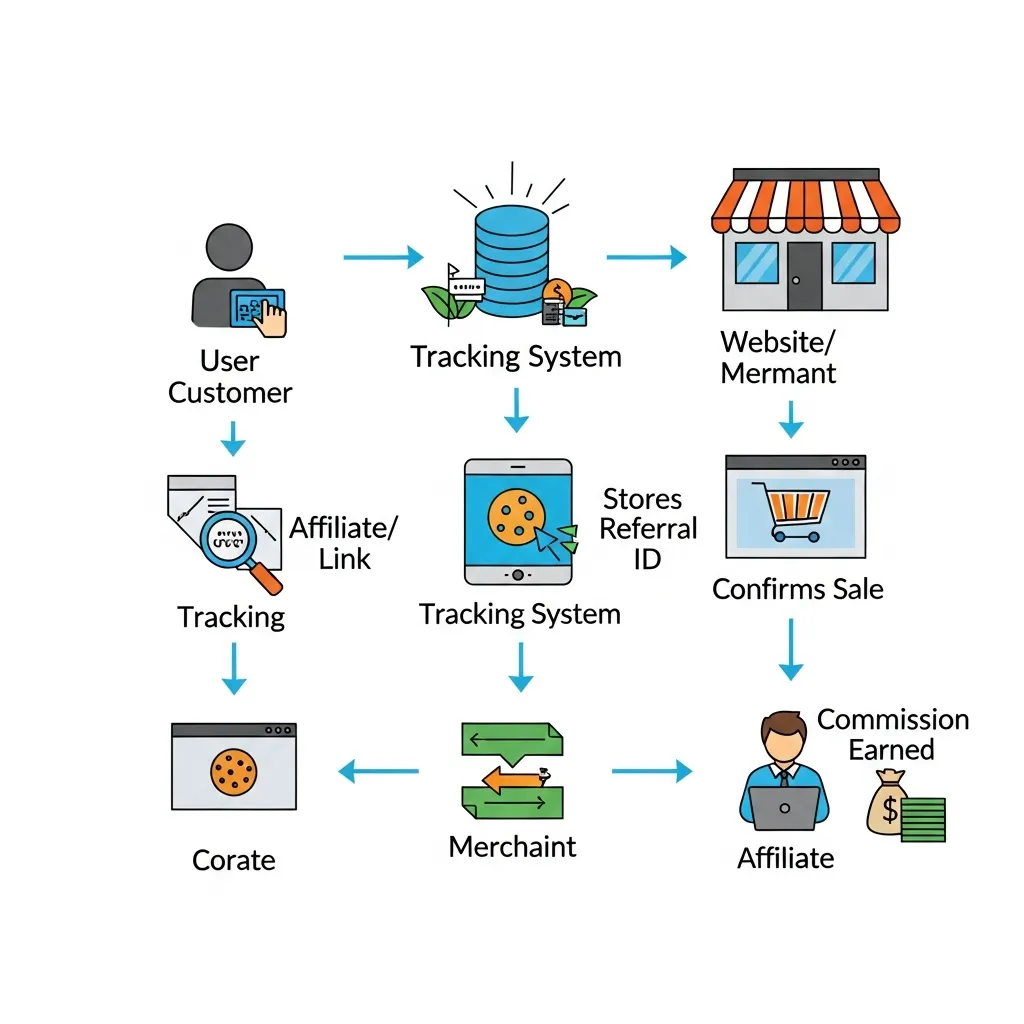
Affiliate tracking explained at its core involves three primary technologies: cookies, tracking pixels, and server-to-server (S2S) tracking. Each method captures data at different points in the customer journey.
Cookies, Pixels, and Server-to-Server Tracking
Cookies are small files stored in a user’s browser when they click an affiliate link. These files record the affiliate ID and timestamp, so when the user converts, the network attributes the sale correctly. Cookie windows typically range from 24 hours (Amazon Associates) to 90 days, depending on the program.
Tracking pixels are tiny, invisible images embedded in web pages or emails. When loaded, they fire a signal back to the tracking platform—recording impressions, page visits, and conversions with more precision than cookies alone.
Server-to-server (S2S) tracking, also called postback tracking, eliminates the browser entirely. Conversion data passes directly between servers, making it far more reliable—especially as third-party cookies phase out across major browsers like Chrome.
Types of Affiliate Tracking Methods
Beyond technology, affiliate tracking explained in practice uses several link-based approaches:
- Tracking links: Unique URLs assigned to each affiliate that record clicks and referral source
- Coupon codes: Useful for social media affiliates without a website; tied directly to the affiliate’s account in the backend
- Phone tracking: Dedicated numbers assigned to affiliates, capturing offline conversions
What Data Points Does Affiliate Tracking Collect?
A robust affiliate tracking system captures: click timestamps, geographic location, device type, browser, referring URL, time-to-conversion, and order value. This data feeds attribution models and helps identify top-performing affiliates.
The Psychology of Affiliate Marketing
Understanding why people buy through affiliate links is just as important as knowing how those links are tracked. The psychology of affiliate marketing centers on trust, social proof, and strategic framing.
How Consumer Behavior Shapes Affiliate Funnels
Consumers rarely convert on the first touchpoint. Research from Google’s “Zero Moment of Truth” study found that buyers consult an average of 10.4 sources before making a purchase decision. Affiliate content—reviews, comparisons, tutorials—plays a central role in that research phase.
The most effective affiliate funnels address specific pain points. A buyer searching “best project management software for remote teams” is much closer to converting than someone searching “what is project management software.” Matching affiliate content to search intent dramatically improves results.
Building Trust Through Recommendations
The psychology of affiliate marketing depends heavily on perceived credibility. Affiliates who disclose their partnerships transparently—and who only recommend products they genuinely use—consistently outperform those who don’t. According to Edelman’s 2023 Trust Barometer, 71% of consumers say they trust recommendations from people they follow online more than traditional advertising.
Emotional Triggers and Persuasive Language
Effective affiliate content uses specific psychological triggers:
- Scarcity: “Limited spots available” or “offer ends Sunday”
- Social proof: User reviews, testimonials, and download counts
- Authority: Citing credentials, case studies, or expert endorsements
- Loss aversion: Framing inaction as a cost (“every day you wait is revenue left on the table”)
Affiliate Call-to-Action Best Practices
A well-tracked affiliate program still fails without compelling calls to action. Affiliate call-to-action best practices focus on clarity, urgency, and placement.
Crafting CTAs That Convert Across Platforms
The language of your CTA should match the platform context:
- Blog posts: “Get [Product] at [Discount]—Limited Time Offer”
- YouTube descriptions: “Click the link below to try [Product] free for 14 days”
- Email newsletters: “Claim your exclusive deal here →”
- Social media: Short, benefit-led copy with a direct link
Avoid vague phrases like “click here” or “learn more.” Specificity drives action.
CTA Placement and Visibility
Placement matters as much as language. The most effective positions for affiliate CTAs include:
- Above the fold on landing pages
- After the problem is identified in long-form content
- At the end of comparison sections, when the reader is ready to decide
- Repeated at multiple scroll depths in long articles (without feeling spammy)
A/B Testing Your CTAs
A/B testing is non-negotiable for serious affiliates. Test one variable at a time: button color, CTA copy, placement, or offer framing. Even small changes—switching “Buy Now” to “Start Saving Today”—can produce double-digit conversion lifts. Tools like Google Optimize and VWO make this straightforward.
Understanding and Improving Affiliate Conversion Rate
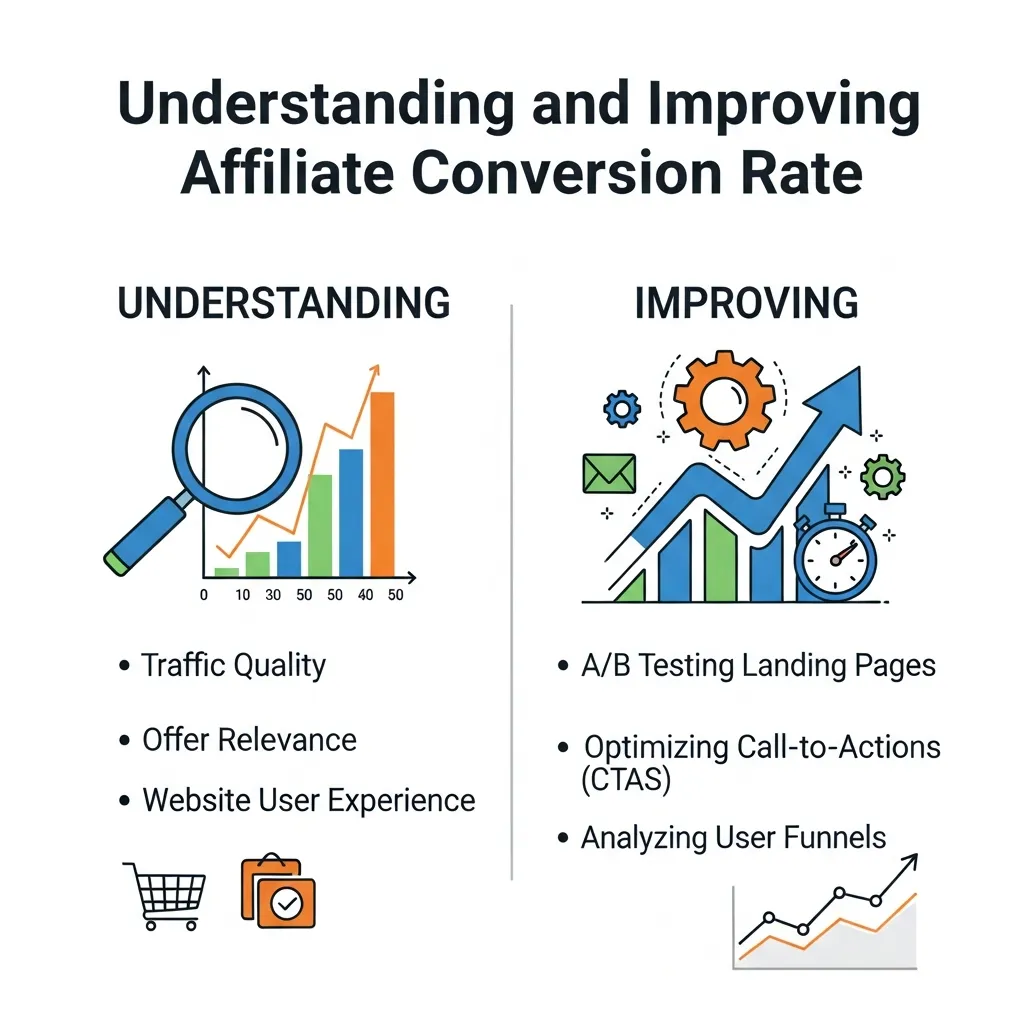
Your affiliate conversion rate is the percentage of clicks that result in a completed action—typically a sale or sign-up. Industry benchmarks vary widely, but a 1–5% affiliate conversion rate is considered solid across most niches.
Key Metrics for Conversion Rate Analysis
Track these alongside raw conversion rate:
- EPC (Earnings Per Click): Total commissions ÷ total clicks
- CTR (Click-Through Rate): How often users click your affiliate links
- AOV (Average Order Value): Higher AOV = higher commissions per conversion
- Bounce rate: High bounce rates on linked landing pages signal a mismatch between your content and the offer
Factors That Influence Affiliate Conversion Rate
Landing page quality is the most significant external factor. If the merchant’s page loads slowly, lacks trust signals, or doesn’t match the promise in your content, conversions drop regardless of how good your affiliate content is.
Offer relevance comes second. A fitness blogger promoting accounting software will see poor results—not because the content is bad, but because the audience intent doesn’t align with the product.
Strategies for Optimizing Conversion Rate
- Use pre-sell pages that warm up the audience before directing them to the merchant
- Match the traffic temperature to the offer (cold audiences need more education; warm audiences need a nudge)
- Test different offers within the same niche to find what resonates
- Improve page speed on any content you control; even a 1-second delay reduces conversions by 7% (Akamai, 2017)
Passive Income with Affiliate Marketing
Passive income with affiliate marketing is real—but it requires active setup. The “passive” part comes after the infrastructure is built.
How Affiliate Marketing Creates Recurring Revenue
The most sustainable affiliate income comes from evergreen content: product reviews, comparison posts, and “best of” listicles that rank in search engines and generate traffic continuously. A single well-ranked article can produce commissions for years with minimal maintenance.
Recurring commission programs—where affiliates earn every month a referred customer stays subscribed—are particularly powerful. SaaS affiliate programs commonly offer 20–30% recurring commissions, meaning a single referral can generate income indefinitely.
Building Sustainable Affiliate Campaigns
Passive income with affiliate marketing depends on three pillars:
- Content depth: Comprehensive, well-researched content outranks thin affiliate pages and earns reader trust
- SEO fundamentals: Keyword research, internal linking, and backlink acquisition determine long-term visibility
- Diversification: Relying on one affiliate program or one traffic source is a single point of failure
Scaling Through Automation
At scale, successful affiliates automate email sequences, use scheduling tools for social content, and leverage affiliate tracking dashboards to monitor performance without manual reporting. Platforms like Post Affiliate Pro and Impact.com provide real-time dashboards that flag underperforming campaigns automatically.
The Role of Conversational AI in Affiliate Marketing
Conversational AI affiliate marketing is one of the fastest-growing intersections in digital marketing. Chatbots and AI assistants are transforming how affiliates engage audiences and recommend products.
How Conversational AI Enhances User Experience
Conversational AI tools—like chatbots built on GPT-4 or Claude—can engage website visitors in real time, answer product questions, and guide users toward the right affiliate offer based on their specific needs. This replaces the static “read and click” experience with an interactive one that mirrors speaking to an expert.
Using Chatbots for Product Recommendations
An affiliate site in the software niche, for example, can deploy a chatbot that asks visitors: “What’s your team size?” and “What’s your main challenge?” before recommending the most relevant tool with an embedded affiliate link. This approach improves relevance, reduces decision fatigue, and increases affiliate conversion rate.
Platforms like ManyChat, Tidio, and Drift offer affiliate-friendly chatbot integrations with tracking capabilities built in.
Measuring the Impact of AI on Affiliate Conversions
Track chatbot-assisted conversions separately in your affiliate tracking platform. Compare conversion rates between chatbot-assisted sessions and non-assisted sessions. Most implementations report a 15–30% lift in conversions when chatbots are used to guide product selection.
Advanced Affiliate Tracking Techniques
Multi-Touch Attribution Models
Most affiliate programs use last-click attribution—giving 100% of the commission to the final affiliate touchpoint before conversion. This underpays affiliates who contribute earlier in the funnel. Multi-touch attribution distributes credit across all touchpoints, giving a more accurate picture of what’s driving revenue.
Common models include:
- Linear: Equal credit to each touchpoint
- Time-decay: More credit to touchpoints closer to conversion
- Position-based: 40% to first and last touch, 20% distributed across the middle
Fraud Detection and Prevention in Affiliate Tracking
Affiliate fraud costs the industry an estimated $1.4 billion annually (Association of National Advertisers, 2023). Common fraud types include click stuffing, fake leads, and cookie dropping. Prevention strategies include:
- Setting minimum time-on-site thresholds before a click counts
- Using IP filtering to block known fraud sources
- Partnering with affiliate networks that have built-in fraud detection (Impact, CJ Affiliate, Partnerize)
Integrating Affiliate Tracking With Other Marketing Tools
Connecting your affiliate tracking platform with your CRM, Google Analytics 4, and email marketing software creates a unified data view. This lets you see how affiliate-referred customers behave over time—their LTV, churn rate, and product usage—giving you leverage to negotiate better commissions or restructure underperforming partnerships.
Challenges and Solutions in Affiliate Tracking

Common Tracking Errors and How to Fix Them
The most frequent affiliate tracking explained problems include:
- Broken tracking links: Test all links before campaigns go live; use link monitoring tools like Lasso
- Attribution gaps: Ensure your tracking code fires on all conversion pages, not just the homepage
- Cookie conflicts: Multiple affiliate programs can overwrite each other’s cookies; S2S tracking resolves this
Adapting to Cookieless Tracking
Google’s deprecation of third-party cookies in Chrome is reshaping affiliate tracking. The shift toward cookieless tracking requires:
- First-party data strategies: Collecting email addresses and building direct relationships
- Server-to-server tracking adoption: Moving away from browser-based tracking entirely
- Contextual targeting: Aligning affiliate content with page context rather than user behavior history
Conclusion
Affiliate tracking explained fully is more than a technical topic—it’s the foundation of a profitable, scalable marketing strategy. From understanding how cookies and pixels capture conversion data, to applying the psychology of affiliate marketing, optimizing your affiliate conversion rate, and leveraging conversational AI affiliate marketing, every element connects to one goal: more reliable, attributable revenue.
The future of affiliate tracking points toward server-to-server measurement, AI-assisted personalization, and privacy-first attribution. Affiliates who adapt early will have a significant advantage over those still relying on third-party cookies and last-click models.
Passive income with affiliate marketing remains one of the most accessible business models available—but only when backed by accurate tracking, smart affiliate call-to-action best practices, and a genuine understanding of what moves your audience to act. Start with the fundamentals covered here, build your systems carefully, and the compounding results will follow.
Frequently Asked Questions
What is the most accurate affiliate tracking method?
Server-to-server (S2S) tracking is currently the most accurate method. It passes conversion data directly between servers, bypassing browser limitations like cookie blocking or ad blockers. S2S tracking is especially valuable as third-party cookies continue to be phased out across major browsers.
How do cookies work in affiliate tracking?
When a user clicks an affiliate link, a small file (cookie) is stored in their browser containing the affiliate’s unique ID and a timestamp. When the user completes a purchase within the cookie window, the network reads the cookie and attributes the commission to the correct affiliate. Cookie windows typically range from 24 hours to 90 days.
What is a good affiliate conversion rate?
A 1–5% affiliate conversion rate is considered solid across most niches. High-ticket products often convert at the lower end (0.5–1%) but generate higher commissions per sale, while lower-priced digital products can convert at 5–10% or higher with warm, targeted traffic.
Can I do affiliate marketing without a website?
Yes. Affiliates can promote products via YouTube, social media, email newsletters, podcasts, or coupon code partnerships. However, having a website gives you control over SEO-driven traffic and allows you to build long-term passive income with affiliate marketing through evergreen content.
How long does it take to earn passive income with affiliate marketing?
Most affiliates see meaningful passive income within 6–18 months of consistent content creation and SEO work. Results depend heavily on niche competitiveness, content quality, and traffic strategy. Faster results are possible with paid traffic, though profit margins are lower.
What is conversational AI in the context of affiliate marketing?
Conversational AI affiliate marketing refers to using AI-powered chatbots or virtual assistants to engage website visitors, answer product questions, and guide users toward relevant affiliate offers. Tools built on large language models can personalize recommendations in real time, improving both user experience and affiliate conversion rate.
How can I prevent affiliate fraud?
Prevent affiliate fraud by using a tracking platform with built-in fraud detection, setting minimum engagement thresholds (e.g., time-on-site before a click counts), filtering suspicious IP addresses, and auditing affiliate partners regularly. Networks like Impact and CJ Affiliate include automated fraud screening.
What are the legal requirements for affiliate disclosure?
In the United States, the FTC requires affiliates to clearly disclose any material connection to a product they recommend—including paid commissions. Disclosures must be clear, conspicuous, and placed near the affiliate link or recommendation, not hidden in footers or fine print. Similar rules apply in the UK (ASA) and EU.
How often should I check my affiliate tracking data?
Check high-traffic campaigns daily and review broader performance weekly. Monthly audits should cover conversion rate trends, top-performing affiliates, and any unexplained drops in EPC. Real-time dashboards on platforms like Impact or Post Affiliate Pro make daily monitoring efficient.
What is server-to-server tracking?
Server-to-server (S2S) tracking, also called postback URL tracking, records conversions by passing data directly between the merchant’s server and the affiliate network’s server—without relying on a user’s browser. This makes affiliate tracking explained in the S2S context far more reliable than cookie-based methods, especially on mobile devices.
How can I choose the right affiliate network for tracking?
Evaluate affiliate networks based on: tracking reliability (look for S2S support), commission structure, payment terms, fraud protection, and the quality of available offers in your niche. Leading networks include Impact, CJ Affiliate, ShareASale, Rakuten, and PartnerStack (strong for SaaS).
What are the benefits of integrating affiliate tracking with a CRM?
Integrating affiliate tracking with a CRM lets you see the full customer lifecycle of affiliate-referred users—including their lifetime value, retention rate, and product usage. This data helps you identify which affiliate partnerships drive the most valuable customers, not just the most conversions, enabling smarter commission negotiations and budget allocation.