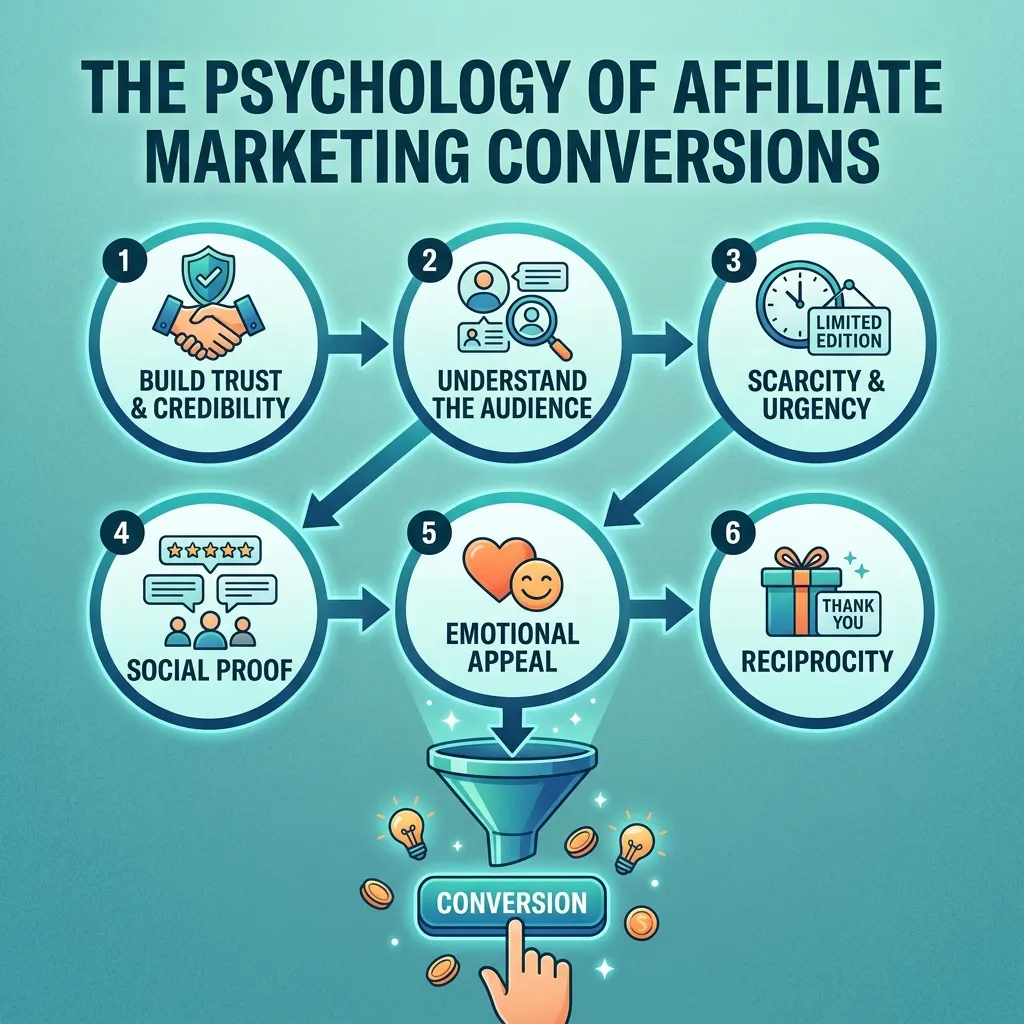
The Psychology of Affiliate Marketing Conversions examines how human behavioral triggers—scarcity, social proof, authority, and reciprocity—drive purchase decisions. Affiliates who apply these principles across Digital Marketing Channels, landing pages, and CTAs consistently Increase Affiliate Conversion Rate and build scalable Passive Income with Affiliate Marketing.
Affiliate marketing generates over $8.2 billion in annual revenue in the United States alone, according to Statista (2023). Yet most affiliates focus almost entirely on traffic volume, overlooking the far more powerful lever: human psychology.
The difference between a link that converts and one that doesn’t rarely comes down to the product. More often, it comes down to how that product is presented—how it makes someone feel, what fears or desires it activates, and whether it earns trust before asking for a click. Understanding the Psychology of Affiliate Marketing Conversions gives marketers the tools to answer all three questions with confidence.
This post breaks down the core psychological principles that drive affiliate conversions, explains how to apply them across Digital Marketing Channels, and provides concrete strategies for Affiliate Landing Page Optimization, crafting a high-impact Affiliate Call-To-Action, and building Passive Income with Affiliate Marketing that lasts.
Core Psychological Principles Driving Conversions
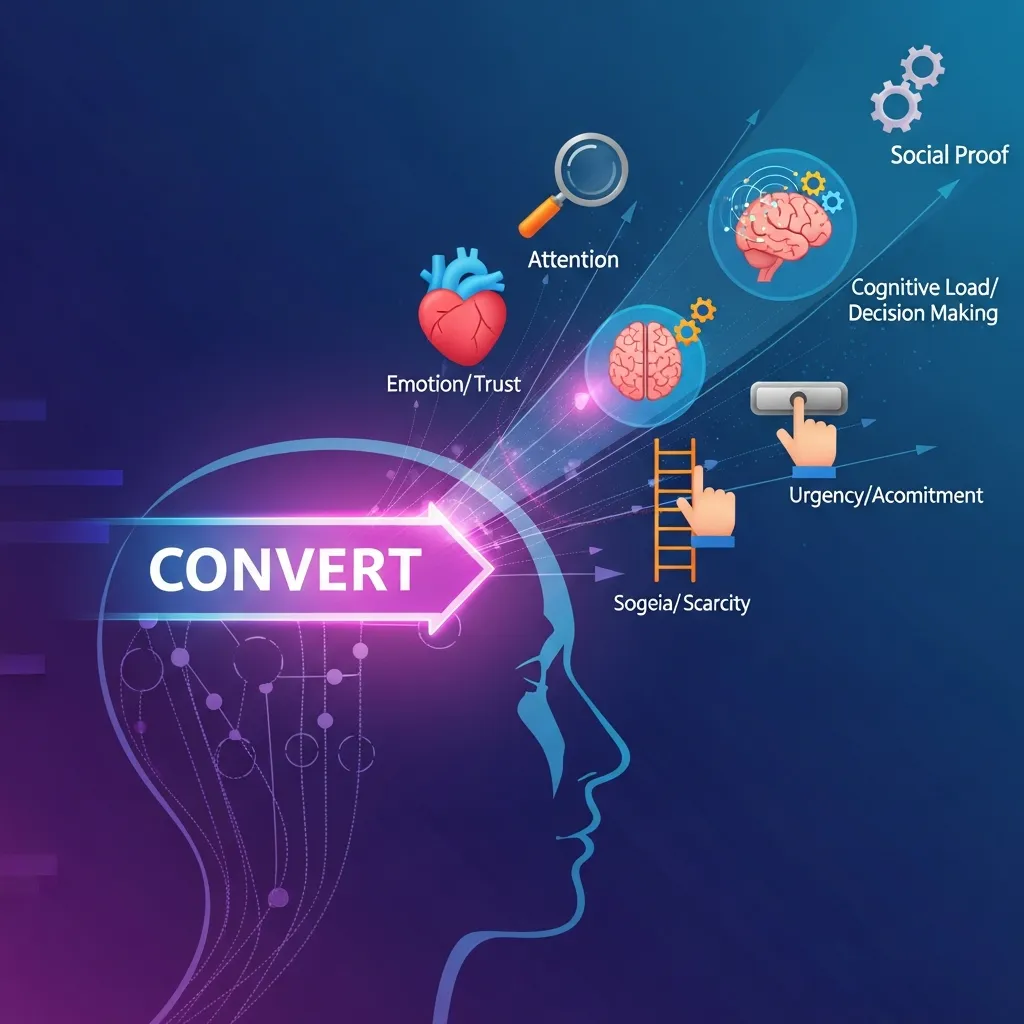
How Does Scarcity and Urgency Drive Affiliate Sales?
Scarcity triggers a deeply human fear: the fear of missing out. When people believe an opportunity is limited, they assign it more value. This cognitive bias—known in behavioral economics as “loss aversion”—means the pain of losing something outweighs the pleasure of gaining it.
For affiliates, this translates into three practical tools:
- Limited-time offers: Countdown timers on promotional pages create genuine urgency. A study by OptinMonster found that countdown timers can increase conversions by up to 332%.
- Stock scarcity: Phrases like “Only 3 left in stock” activate the same fear response, particularly in e-commerce affiliate promotions.
- Exclusive access: Positioning an offer as invite-only or subscriber-exclusive elevates perceived value and speeds up decision-making.
The key is authenticity. Fake scarcity erodes trust and—in some regions—violates consumer protection laws.
Why Is Social Proof So Effective at Increasing Affiliate Conversion Rate?
Humans are wired to look at others when making decisions. Robert Cialdini, in his foundational work Influence: The Psychology of Persuasion (1984), identified social proof as one of the six core principles of persuasion. Decades later, it remains one of the most reliable ways to Increase Affiliate Conversion Rate.
Effective forms of social proof include:
- Testimonials and reviews: According to BrightLocal (2023), 88% of consumers trust online reviews as much as personal recommendations.
- Influencer endorsements: Micro-influencers (10,000–100,000 followers) often generate higher engagement rates than celebrity accounts, making them valuable partners across Digital Marketing Channels.
- User-generated content (UGC): Real photos, videos, and stories from actual customers carry more persuasive weight than polished brand content.
How Does Authority Build Trust in Affiliate Marketing?
People defer to experts. When an affiliate positions themselves—or their recommended product—as an authoritative source, resistance to conversion drops significantly.
Authority can be established through expert recommendations, brand reputation, and third-party validation such as certifications, awards, or media mentions. An affiliate blogger who holds a relevant professional credential, for example, converts at a measurably higher rate than one without visible expertise, all else being equal.
What Role Does Reciprocity Play in Affiliate Conversions?
Give something valuable before asking for anything in return. This is the principle of reciprocity, and it works because it activates an almost universal social norm: the obligation to return a favor.
In affiliate marketing, reciprocity shows up as:
- Free e-books, templates, or webinars offered before a product recommendation
- Exclusive early-bird discounts for email subscribers
- Freemium tools that demonstrate product value before the purchase ask
The Psychology of Affiliate Marketing Conversions is, at its core, about building goodwill first.
How Do Liking and Consistency Influence Affiliate Buyer Behavior?
People buy from those they like and trust. Personalized communication, consistent storytelling, and a recognizable brand personality all accelerate this connection.
Commitment and consistency work alongside liking. Once someone makes a small initial commitment—subscribing to a newsletter, downloading a free guide, joining a loyalty program—they become far more likely to follow through with a purchase. This “foot-in-the-door” technique is a well-documented behavioral pattern that every affiliate should build into their funnel.
Optimizing Digital Marketing Channels for Conversion
Which Digital Marketing Channels Work Best for Affiliate Conversions?
Not all channels carry the same psychological weight. The best Digital Marketing Channels for affiliate conversion are those that allow for trust-building over time.
Content marketing (blog posts, video, podcasts) creates value before the pitch. Long-form content ranks well in search, builds authority, and provides multiple opportunities to embed affiliate links naturally. Video content, in particular, activates social proof and liking simultaneously—viewers feel they know the creator before they ever click a link.
Email marketing remains the highest-ROI digital channel, with an average return of $36 for every $1 spent (Litmus, 2023). Segmentation and personalization ensure that recommendations feel relevant rather than generic. Automated email sequences—built around behavioral triggers like page visits or previous purchases—allow affiliates to nurture leads with the right message at the right time.
Social media marketing accelerates community-building and social proof. Platform-specific strategies matter: short-form video performs on TikTok and Instagram Reels, while detailed reviews and comparisons resonate more on YouTube and Pinterest. Interactive content—polls, Q&As, comment-driven threads—creates micro-commitments that warm audiences before conversion.
Crafting an Effective Affiliate Call-To-Action

What Makes an Affiliate Call-To-Action Convert?
An Affiliate Call-To-Action is the single moment where psychology meets behavior. Everything else in your funnel leads here. A weak CTA wastes all the trust you’ve built; a strong one channels it into action.
Three principles define a high-converting Affiliate Call-To-Action:
- Clear, concise language: Remove ambiguity. “Shop Now and Save 20%” beats “Click Here” because it specifies what happens and why it benefits the user.
- Urgency and benefit-driven framing: “Download Your Free Guide” pairs immediate action with immediate reward. “Start Your Free Trial Today” removes financial risk from the equation.
- Placement and design: CTAs placed above the fold, in contrasting colors, and repeated at key scroll points consistently outperform buried, single-instance buttons.
The most effective Affiliate Call-To-Action options tend to follow a simple formula: action verb + specific benefit + low friction. Test multiple variations to find what resonates with your specific audience.
Affiliate Landing Page Optimization Strategies
How Does Affiliate Landing Page Optimization Increase Conversions?
Affiliate Landing Page Optimization bridges the gap between a click and a conversion. The landing page is where psychology meets user experience, and small design decisions carry outsized impact.
UX and UI fundamentals: Clean, uncluttered layouts reduce cognitive load. Easy navigation prevents confusion. Mobile responsiveness is non-negotiable—Google reports that more than 60% of online searches now occur on mobile devices.
Trust signals: Security badges, visible privacy policies, and accessible customer support information address the rational hesitations that undermine emotional buying impulses. These elements are especially critical in affiliate niches like finance, health, and software.
Personalization and relevance: Dynamic content that adapts based on the referring source, user behavior, or browsing history makes offers feel tailored rather than generic. Affiliate Landing Page Optimization at this level—matching landing page messaging to the ad or content that drove the click—can improve conversion rates by 40–50%, according to Unbounce research.
Increasing Affiliate Conversion Rate Through Data and Analytics
What KPIs Should Affiliates Track to Increase Affiliate Conversion Rate?
Data closes the loop between psychology and performance. To consistently Increase Affiliate Conversion Rate, affiliates need to track:
- Click-through rate (CTR): Measures CTA and content effectiveness
- Conversion rate: The percentage of visitors who complete the desired action
- Earnings per click (EPC): A direct measure of campaign profitability
- Bounce rate and time-on-page: Indicators of content and UX quality
A/B testing is the most reliable method for optimizing these metrics. Test one variable at a time—headline, CTA color, page layout, offer framing—and run each test long enough to reach statistical significance. Small improvements compound quickly. A 1% improvement in conversion rate, applied across thousands of monthly visitors, can meaningfully Increase Affiliate Conversion Rate over time.
Understanding user journeys and drop-off points is equally important. Heatmaps (via tools like Hotjar), session recordings, and funnel analytics reveal exactly where users lose interest—and why.
Passive Income with Affiliate Marketing: A Psychological Perspective

How Does Psychology Support Long-Term Passive Income with Affiliate Marketing?
Passive Income with Affiliate Marketing is built on trust compounded over time. The psychological principles that drive single conversions—authority, reciprocity, liking—become structural advantages when maintained consistently.
Long-term trust is cultivated through honest reviews, transparent disclosures, and consistent content quality. Affiliates who prioritize their audience’s interests over short-term commissions retain that audience far longer, generating repeated conversions from the same loyal base.
Scaling Passive Income with Affiliate Marketing requires two things: evergreen content and system automation. Evergreen blog posts and videos continue to rank and convert months or years after publication, generating income without ongoing effort. Automated email sequences, pre-scheduled social content, and programmatic landing page personalization remove the need for constant manual intervention.
The affiliates who earn the most sustainable Passive Income with Affiliate Marketing aren’t those with the most traffic. They’re the ones whose audiences trust them enough to buy on recommendation alone.
Conclusion
The Psychology of Affiliate Marketing Conversions is not a collection of manipulation tactics. It’s a framework for understanding how people make decisions—and designing affiliate experiences that align with those natural processes.
Scarcity, social proof, authority, reciprocity, liking, and consistency are not marketing inventions. They are human constants. Affiliates who apply them thoughtfully, across well-optimized Digital Marketing Channels, with compelling Affiliate Call-To-Action copy and robust Affiliate Landing Page Optimization, consistently outperform those who rely on volume alone.
Start by auditing one element of your current funnel through a psychological lens. Is your landing page building trust before asking for action? Does your CTA communicate a clear benefit? Are you using social proof where hesitation is highest? Small, targeted changes—grounded in behavioral science—can Increase Affiliate Conversion Rate faster than any traffic strategy.
The path to meaningful, scalable Passive Income with Affiliate Marketing runs directly through your audience’s psychology. Understand it, and the conversions follow.
Frequently Asked Questions About the Psychology of Affiliate Marketing Conversions
1. What is the Psychology of Affiliate Marketing Conversions?
The Psychology of Affiliate Marketing Conversions focuses on how behavioral triggers like scarcity, social proof, authority, and reciprocity influence people to click affiliate links and complete purchases. It helps marketers understand why users convert and how to design content, landing pages, and offers that encourage action.
2. Which psychological trigger has the biggest impact on affiliate conversions?
Social proof is one of the strongest drivers in the Psychology of Affiliate Marketing Conversions because people often trust reviews, testimonials, and user experiences before making a purchase. When used well, it can significantly improve credibility and conversion rates.
3. How can I use scarcity ethically in affiliate marketing?
In the Psychology of Affiliate Marketing Conversions, ethical scarcity means highlighting real limitations such as genuine discounts, time-sensitive offers, or limited stock. False urgency may boost short-term clicks, but it damages trust and hurts long-term affiliate performance.
4. What is affiliate landing page optimization?
Affiliate landing page optimization is the process of improving page design, copy, trust signals, and user experience to increase conversions. Within the Psychology of Affiliate Marketing Conversions, landing page optimization matters because small changes in layout, CTA placement, or messaging can strongly influence user behavior.
5. How do I write a high-converting affiliate CTA?
A strong CTA is a key part of the Psychology of Affiliate Marketing Conversions. It should use clear action language, highlight a specific benefit, and reduce friction. Phrases like “Start Your Free Trial” or “Get the Discount Now” usually perform better than generic calls to action.
6. Which digital marketing channels work best for affiliate conversions?
The best channels for applying the Psychology of Affiliate Marketing Conversions often include email marketing, SEO-driven content, and social media. These channels allow you to build trust, educate your audience, and present offers in a way that feels natural and persuasive.
7. How can I increase affiliate conversion rates without getting more traffic?
To improve results through the Psychology of Affiliate Marketing Conversions, focus on better CTAs, stronger trust signals, clearer product positioning, and landing page improvements. A/B testing and personalization can often lift conversions without increasing traffic.
8. What metrics should I track for affiliate conversion performance?
When measuring the Psychology of Affiliate Marketing Conversions, key metrics include click-through rate, conversion rate, earnings per click, bounce rate, and time on page. These numbers help show how effectively your content and pages are influencing buying behavior.
9. How does reciprocity work in affiliate marketing?
Reciprocity is a core principle in the Psychology of Affiliate Marketing Conversions. When you offer useful value first—such as a free guide, tutorial, checklist, or discount—people are more likely to trust your recommendation and take action through your affiliate link.
10. Can the Psychology of Affiliate Marketing Conversions help build passive income?
Yes, the Psychology of Affiliate Marketing Conversions can support long-term passive income by helping you create content and funnels that convert consistently over time. When combined with evergreen content and trust-building strategies, psychological triggers can keep generating sales with less ongoing effort.
11. What is the foot-in-the-door technique in affiliate marketing?
The foot-in-the-door technique is a persuasion strategy often used in the Psychology of Affiliate Marketing Conversions. It starts with a small action, such as signing up for a newsletter or downloading a free resource, before asking the user to make a larger commitment like a purchase.
12. Why is mobile optimization important for affiliate conversions?
Mobile optimization is essential to the Psychology of Affiliate Marketing Conversions because many users discover affiliate content on their phones. If your landing page loads slowly or is difficult to use on mobile, even strong persuasive copy may fail to convert.