Affiliate marketing remains a cornerstone of success for modern brands. When setting up an affiliate program, companies must decide how to compensate their partners. The debate between revenue share vs fixed commission affiliate models is a critical one. This article explores the distinct advantages and disadvantages of each payout structure. By understanding these differences, businesses can optimize their Types of Affiliate Marketing strategies to align with their financial goals and customer acquisition targets.
Marketing teams constantly search for the most effective ways to drive growth. Digital Advertising provides a wealth of channels, but few are as performance-driven as affiliate marketing. This strategy allows businesses to partner with external promoters who earn a payout for driving specific actions. The beauty of this system lies in its performance-based nature, meaning you only pay for actual results.
However, deciding exactly how to pay those partners can be complicated. Brands typically choose between two primary payout structures. Navigating the nuances of revenue share vs fixed commission affiliate models requires a deep understanding of your business margins, customer lifetime value, and overall marketing goals.
Choosing the wrong model can lead to misaligned incentives or unpredictable costs. Selecting the right one can create a highly motivated army of promoters who scale your revenue efficiently. We will explore both options in detail, helping you determine which approach best suits your digital strategy.
Introduction to Affiliate Marketing in Digital Advertising

What is Affiliate Marketing?
Affiliate marketing is a performance-based advertising strategy. A business rewards one or more affiliates for each visitor or customer brought by the affiliate’s own marketing efforts. The core principle revolves around revenue sharing and performance incentives.
This ecosystem relies on three main parties. The merchant creates the product or service. The affiliate promotes that product to their audience. Finally, the consumer clicks the affiliate link and makes a purchase, triggering a payout from the merchant to the affiliate.
The Rise of Affiliate Marketing in Digital Advertising
Historically, affiliate marketing began as simple referral programs in the late 1990s. As Digital Advertising evolved, so did affiliate networks. Tracking technology became sophisticated enough to attribute sales accurately across different devices and platforms.
Today, it serves as a powerful tool for customer acquisition and return on investment (ROI). Businesses love it because it minimizes upfront advertising costs. Affiliates love it because it offers a flexible way to monetize their audience. Whether a brand works with bloggers, influencers, or a specialized TikTok ads agency, the performance-driven nature ensures a focus on tangible results.
Key Players in Affiliate Marketing
The affiliate ecosystem relies on robust infrastructure. Affiliate networks act as intermediaries, connecting merchants with willing affiliates. Platforms like ShareASale, CJ Affiliate, or Impact provide the necessary tracking links, payment processing, and reporting dashboards. These tracking tools ensure every click, lead, and sale is accurately recorded, forming the foundation of any payout model.
Understanding Fixed Commission Affiliate Models
Definition and Mechanics
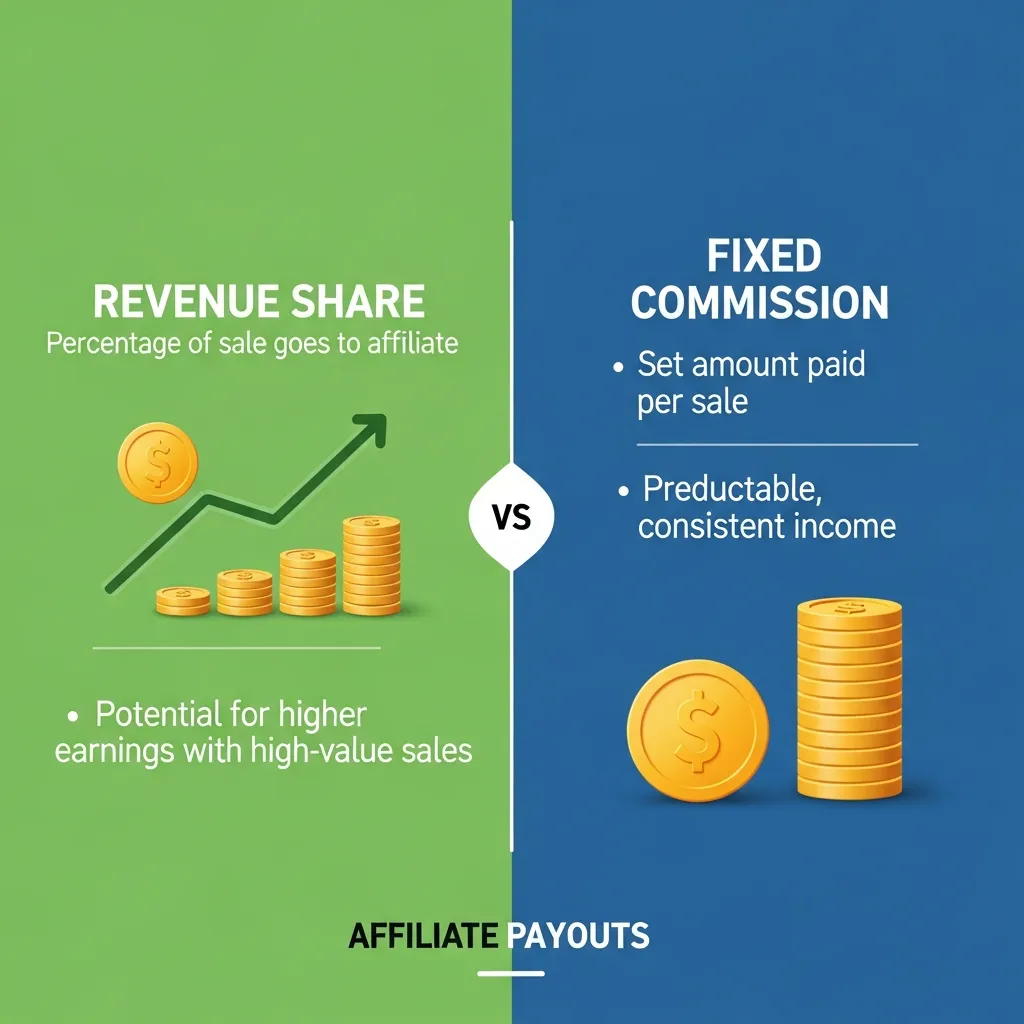
A fixed commission model pays the affiliate a set monetary amount for a specific action. This is often structured as Cost Per Action (CPL) or Cost Per Lead (CPL). The payout remains exactly the same regardless of the total cart value.
For example, a software company might pay an affiliate $50 for every new user who signs up for a paid plan. A clothing brand might pay $10 for every email newsletter sign-up. The mechanics are straightforward: action equals a predetermined payout.
Advantages of Fixed Commission
Merchants benefit heavily from predictable costs. Budgeting becomes incredibly easy when you know exactly how much acquiring a new customer will cost.
This model offers great simplicity in tracking and payment. Accounting teams can easily forecast expenses. Furthermore, it provides clear incentives for affiliates based on conversions. They know exactly how much they will earn for their efforts, making it easier for them to calculate their own advertising spend.
Disadvantages of Fixed Commission
This approach has some drawbacks. Affiliates might experience lower payouts for high-value sales. If an affiliate drives a customer who purchases $1,000 worth of goods, a fixed $20 payout might feel inadequate.
For merchants, there is less alignment with long-term customer value. Affiliates are motivated to drive volume, not necessarily high-spending or loyal customers. There is also a distinct risk of fraud or low-quality leads if the qualifying action is simple, such as filling out a free form.
Best Use Cases for Fixed Commission
Certain campaigns thrive under this structure. New product launches benefit from the sheer volume of traffic fixed commissions can generate. Lead generation campaigns, where the goal is to build an email list, also work well. Additionally, businesses selling high-volume, low-value products often prefer this model to protect their margins.
Exploring Revenue Share Affiliate Models
Definition and Mechanics
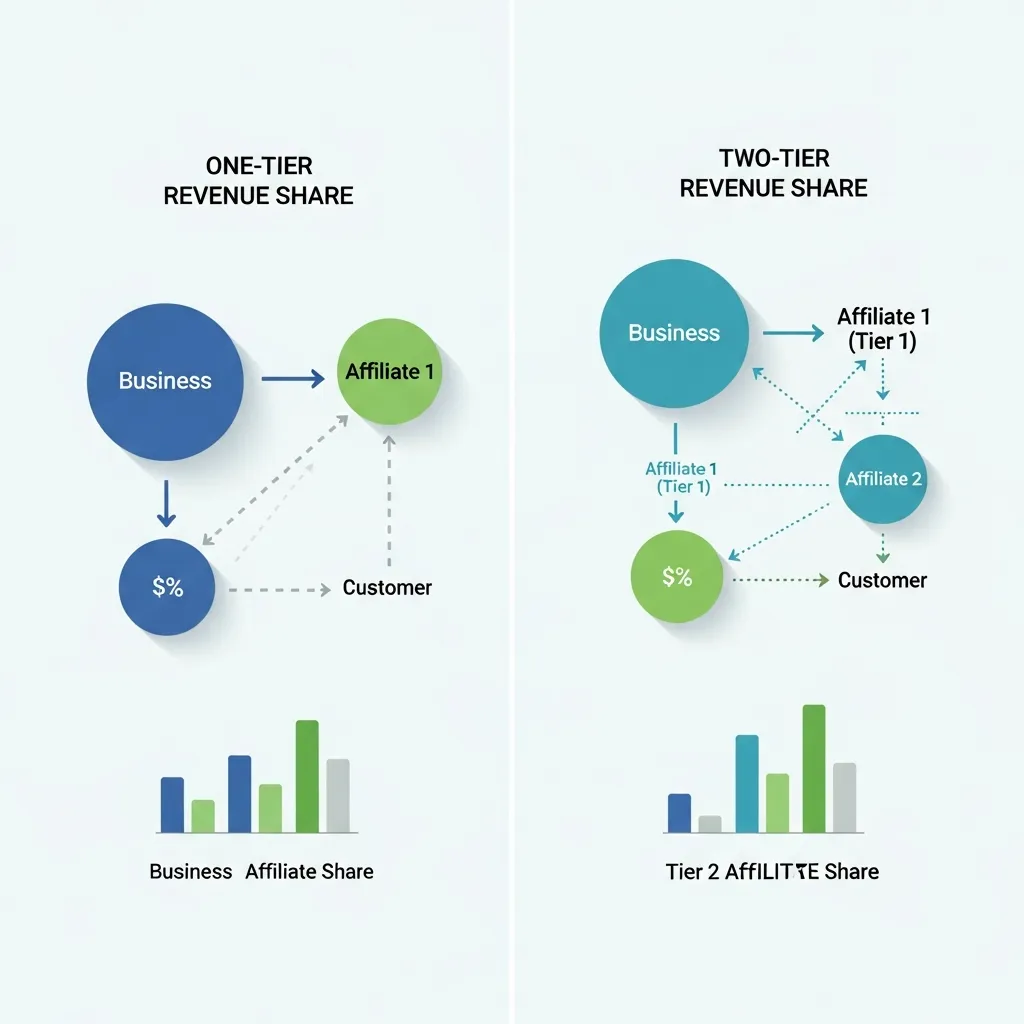
Under a revenue share structure, the affiliate earns a percentage of the total sale amount. This can apply to an initial purchase or extend into recurring revenue for subscription products.
For instance, an e-commerce store might offer a 10% commission on the total cart value. If a customer spends $100, the affiliate earns $10. If they spend $500, the affiliate earns $50. In a Software as a Service (SaaS) environment, the affiliate might earn 20% of the customer’s monthly subscription fee for as long as they remain an active user.
Advantages of Revenue Share
The primary benefit is the strong alignment between merchant and affiliate interests. It represents a truly shared success metric. When the merchant makes more money, the affiliate makes more money.
This leads to higher potential earnings for affiliates, especially for high-value or recurring sales. Because their payout scales with the customer’s spending, it naturally encourages affiliates to drive higher-quality, higher-spending customers.
Disadvantages of Revenue Share
Cost predictability suffers under this model. Merchants cannot know exactly how much they will pay out until the sales actually occur.
Tracking and calculation become significantly more complex, especially for recurring revenue models where subscription cancellations and upgrades must be factored in. Furthermore, this model requires more trust and transparency between parties, as affiliates rely on the merchant to accurately report total sale values and recurring billing cycles.
Best Use Cases for Revenue Share
Businesses offering subscription services are prime candidates for this model. It also works exceptionally well for high-value products and services, where affiliates need a substantial incentive to close a difficult sale. Companies focused on long-term customer relationships find this model highly effective, as it aligns the affiliate’s compensation with the lifetime value of the user.
Revenue Share vs Fixed Commission: A Comparative Analysis
Cost Predictability and Budgeting
When comparing revenue share vs fixed commission affiliate models, budgeting is a major differentiator. Fixed commissions allow merchants to allocate exact budgets for customer acquisition. Revenue share models require more fluid financial planning, as expenses scale directly with revenue.
Affiliate Motivation and Behavior
Incentives dictate behavior. Fixed models encourage affiliates to focus on conversion volume. They want as many people to complete the action as possible. Revenue share models encourage affiliates to focus on customer quality. They will tailor their content to attract buyers who are likely to spend large amounts or remain subscribed for long periods.
Risk and Reward for Merchants
Fixed commissions carry the risk of overpaying for low-value customers, but they protect margins on high-ticket sales. Revenue share minimizes the risk of paying for unprofitable customers, but merchants must surrender a portion of their highest-value sales.
Tracking and Reporting Complexity
Technological requirements vary greatly. Fixed payouts only require tracking a single conversion event. Revenue share requires deep integration with shopping carts, billing systems, and potentially CRM platforms to accurately track recurring payments and total order values.
Alignment with Business Objectives
Your choice must match your sales goals. If brand building and rapid customer acquisition are the goals, fixed models work best. If maximizing customer lifetime value and maintaining strict profitability on every single transaction is the priority, revenue share is superior.
Examples in Types of Affiliate Marketing
Consider a fitness supplement brand. They might use a fixed commission to pay a TikTok ads agency for every free sample requested. Conversely, a high-end web hosting company will likely use a recurring revenue share model to incentivize tech bloggers to refer long-term, high-paying enterprise clients. Both Types of Affiliate Marketing work beautifully when aligned with the right payout structure.
Choosing the Right Model for Your Digital Advertising Strategy

Your decision should be based on your product’s price point, your profit margins, and your tracking capabilities.
Start by calculating your customer lifetime value. If your customers tend to make single, predictable purchases, fixed commissions offer a clean, manageable system. If your business relies on upsells, cross-sells, or ongoing subscriptions, revenue sharing creates a powerful, motivated partnership with your affiliates. Many successful brands utilize a hybrid approach, offering a small fixed bounty for a lead and a percentage of any subsequent sales.
Next Steps for Your Affiliate Program
Optimizing your Digital Advertising efforts requires constant refinement. Review your current margins, assess the technical capabilities of your affiliate platform, and speak directly with your top-performing partners to understand what motivates them. By carefully evaluating revenue share vs fixed commission affiliate models, you can build a highly profitable, scalable marketing channel that drives sustainable growth for your brand.